A secondary school in Oradea, Romania has taken some wonderful images using the Faulkes Telescopes and LCO Network. One of their physics teachers, Valentina Matei shared their story with us:
I teach physics for 12-14 years old students at “Dacia” Secondary School in Oradea, Romania. I teach Astronomy in extracurricular activities for 13 years old students in my school. I love astronomy and space science, so I took part in professional development programs in this domain. I also participated at “Honeywell Educators at Space Academy” program in July 2008 and 2011 (advanced level) at U.S. Space & Rocket Center in Huntsville, Alabama, USA, and “Astronomy Education Adventure in the Canary Islands”, July 2020 (online).
I use interdisciplinary teaching in order to increase students’ motivation and learning for science. Astronomy is part of our culture’s history and roots. For us, to study deep-sky objects as galaxies, nebula, star clusters, using high level telescopes from Hawaii and Australia, in the Faulkes Telescope Project is a dream come true.
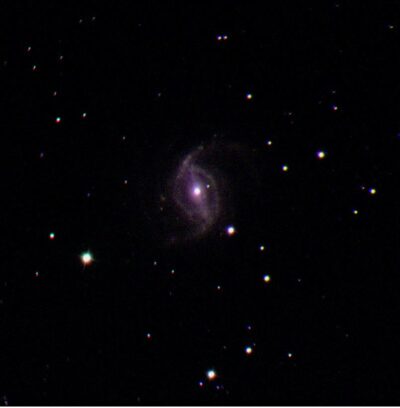
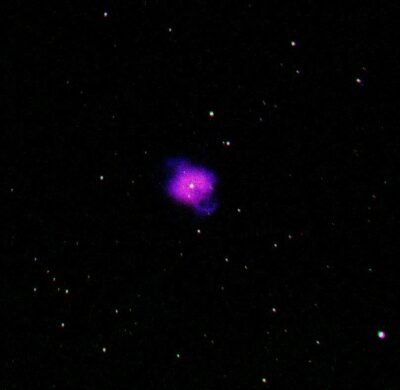
We tool pictures of galaxies, a nebula and star cluster. We used SalsaJ to display, analyse and explore these images. Our favourite picture is M47.
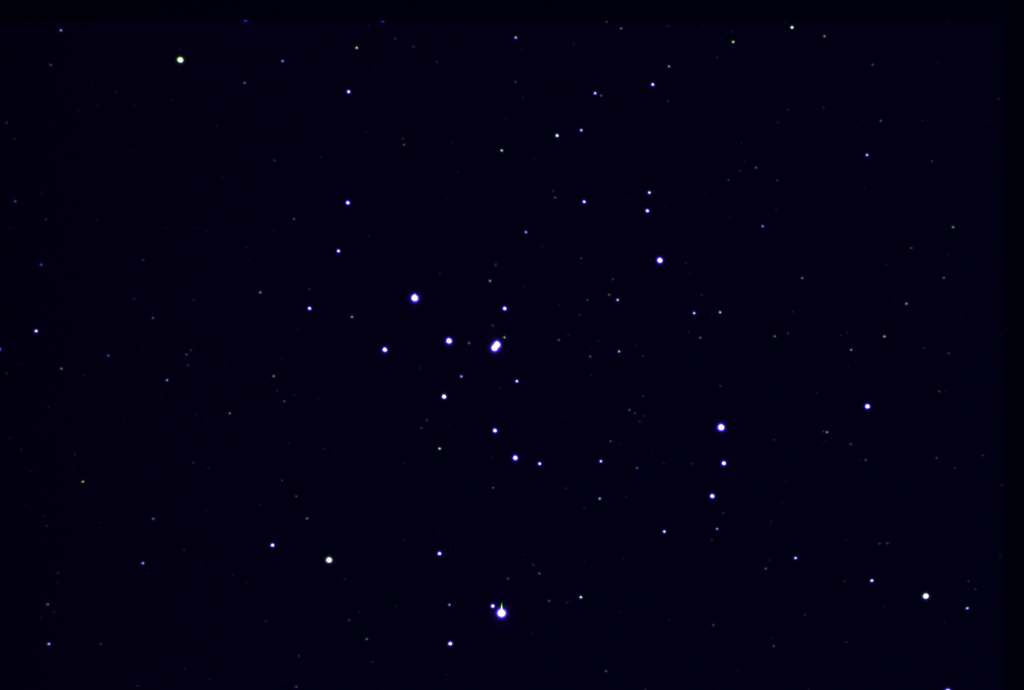
Studying the structure of our Galaxy is a challenging task. One of the ways to investigate the Galactic structure is through studying the properties of various classes of objects that populate the Galaxy. The formation and evolution of the Galaxy can be probed through open star clusters, which are groups of stars that formed from the same molecular cloud and have roughly the same age, distance and chemical composition.
Messier 47 (M47 or NGC 2422) is one of the least densely populated open clusters, located approximately 1600 light-years from our solar system, in the southern constellation of Puppis. The open cluster began their life around 78 million years ago and now cruising away from our solar system at a speed of 9 kilometres per second. An open cluster presents an opportunity for observing star colours. The blue colour of the brightest stars is an indicator of their temperature, with hotter stars appearing bluer and cooler stars appearing redder. The brightest stars of this cluster are spectral class B2 and magnitude 5.7. It also contains two orange K giants with luminosity of about 200 times that of the Sun.
The bright star nearest to the centre of Figure 2 is the fine double star, Sigma 1121 with components of magnitude both 7.8 and separated by 7.4 arc seconds.
Thank you for the opportunity to join this amazing project in order to discover the Universe!
________________________________________________
The Astronomy Education Adventures in the Canary Islands will be taking place again next year, this time in Tenerife! To find out more information and how to apply, visit the website here.
]]>First spotted on 23rd November by the DLT40 survey based in Chile, (http://dark.physics.ucdavis.edu/dlt40/DLT40) this supernova is a Type II supernovae which results from the very quick collapse and violent explosion of a massive star once it gets to the end of its life.
The supernova can be seen in the image below (taken by Pete Williamson using the 2m FTS with the V filter for 90s).
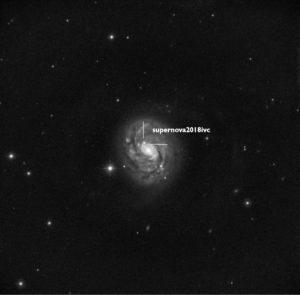
Astronomers are interested in any follow-up images of this supernova so that they can see how its light changes over time. For more information on this supernova, follow this link here: http://www.rochesterastronomy.org/sn2018/sn2018ivc.html. On this page, a list of images can be seen, along with a request for further observations – so why not get your students involved in helping these astronomers by taking some observations of this pretty galaxy a snap the supernova at the same time!
Further details can be found below.
Observing details:
Name of Galaxy: M77
Filter and exposure times: If imaging with 2m ( recommended ) use 90s with R filter, 90 Seconds with V Filter and 120 seconds with the B filter.
Coordinates: RA = 02:42:41.29 DEC = -00:00:31.71
Linked Activities:
For an introduction to plotting supernovae light curves, the FT resources site has an activity here: http://resources.faulkes-telescope.com/course/view.php?id=68
To read more about the lifecycle of stars, supernovae, and plot a lightcurve of a supernova discovered by the ESA Gaia mission, have a look here: http://resources.faulkes-telescope.com/course/view.php?id=141
To find out more about using the Real-Time interface or queue observing: follow this link: http://www.faulkes-telescope.com/observing/
]]>
Context. Edge-on galaxies can offer important insights in galaxy evolution as they are the only systems where the distribution of the different components can be studied both radially and vertically. The HEROES project was designed to investigate the interplay between the gas, dust, stars and dark matter (DM) in a sample of 7 massive edge-on spiral galaxies.
Aims. In this second HEROES paper we present an analysis of the atomic gas content of 6 out of 7 galaxies in our sample. The remaining galaxy was recently analysed according to the same strategy. The primary aim of this work is to constrain the surface density distribution, the rotation curve and the geometry of the gas disks in a homogeneous way. In addition we identify peculiar features and signs of recent interactions.
Methods. We construct detailed tilted-ring models of the atomic gas disks based on new GMRT 21-cm observations of NGC 973 and UGC 4277 and re-reduced archival HI data of NGC 5907, NGC 5529, IC 2531 and NGC 4217. Potential degeneracies between different models are resolved by requiring a good agreement with the data in various representations of the data cubes.
Results. From our modelling we find that all but one galaxy are warped along the major axis. In addition, we identify warps along the line of sight in three galaxies. A flaring gas layer is required to reproduce the data only for one galaxy, but (moderate) flares cannot be ruled for the other galaxies either. A coplanar ring-like structure is detected outside the main disk of NGC 4217, which we suggest could be the remnant of a recent minor merger event. We also find evidence for a radial inflow of 15 +- 5 km/s in the disk of NGC 5529, which might be related to the ongoing interaction with two nearby companions.
Read the paper here
]]>Context Galactic starburst clusters play a twin role in astrophysics, serving as laboratories for the study of stellar physics and also delineating the structure and recent star formation history of the Milky Way.
Aims In order to exploit these opportunities we have undertaken a spectroscopic survey of the red supergiant dominated young massive clusters thought to be present at both near and far ends of the Galactic Bar.
Methods Specifically, multi-epoch observations were employed to identify and investigate stellar variability and its potential role in initiating mass loss amongst the cool super-/hypergiant populations of these aggregates.
Results Significant spectroscopic variability suggestive of radial pulsations was found for the yellow supergiant VdBH222 #505. Follow-up photometric investigations revealed modulation with a period of ~ 23.325 d; both timescale and pulsational profile are consistent with a Cepheid classification.
Conclusions #505 is one of the longest period Galactic cluster Cepheids identified to date and hence of considerable use in constraining the bright end of the period/luminosity relation at solar metallicities. In conjunction with extant photometry we infer a distance of ~ 6kpc for VdBH222 and an age of ~ 20Myr. This results in a moderate reduction in both the integrated cluster mass (2 × 10^4 solar masses) and the initial masses of the evolved cluster members (~ 10 solar masses). As such VdBH222 becomes an excellent test-bed for studying the properties of some of the lowest mass stars observed to undergo type-II supernovae. Moreover, the distance is in tension with a location of VdBH222 at the far end of the Galactic Bar. Instead a birthsite in the near 3kpc arm is suggested; providing compelling evidence of extensive recent star formation in a region of the inner Milky Way which has hitherto been thought to be devoid of such activity.
Read the pre-print here
]]>In March this year, we reported on a school in France who had recently begun using the Faulkes Telescopes in their classroom. After attending an EU-HOU/GTTP Astronomy Training Workshop, their teacher, Hevre Faivre, introduced the students to the telescopes, and to a project on galaxies.
To read about their project, and how they linked observations of galaxies with the citizen science project, Galaxy Zoo, click on the link here.
]]>We present results of the detailed dust energy balance study for the seven large edge-on galaxies in the HEROES sample using 3D radiative transfer (RT) modelling. Based on available optical and near-infrared observations of the HEROES galaxies, we derive the 3D distribution of stars and dust in these galaxies. For the sake of uniformity, we apply the same technique to retrieve galaxy properties for the entire sample: we use a stellar model consisting of a Sersic bulge and three double-exponential discs (a superthin disc for a young stellar population and thin and thick discs for old populations). For the dust component, we adopt a double-exponential disc with the new THEMIS dust-grain model. We fit oligochromatic radiative transfer (RT) models to the optical and near-infrared images with the fitting algorithm FitSKIRT and do panchromatic simulations with the SKIRT code at wavelengths ranging from ultraviolet to submillimeter. We confirm the previously stated dust energy balance problem in galaxies: for the HEROES galaxies, the dust emission derived from our RT calculations underestimates the real observations by a factor 1.5-4 for all galaxies except NGC 973 and NGC 5907 (apparently, the latter galaxy has a more complex geometry than we used). The comparison between our RT simulations and the observations at mid-infrared-submillimeter wavelengths shows that most of our galaxies exhibit complex dust morphologies (possible spiral arms, star-forming regions, more extended dust structure in the radial and vertical directions). We suggest that, in agreement with the results from Saftly et al. (2015), the large- and small-scale structure is the most probable explanation for the dust energy balance problem.
Read the preprint here
]]>