-
Faulkes Telescope Project Privacy Policy
Snap a supernova!
A new supernova has been discovered in the spiral galaxy M77 and we are encouraging schools to help astronomers by taking follow up observations of this newly exploded star.
First spotted on 23rd November by the DLT40 survey based in Chile, (http://dark.physics.ucdavis.edu/dlt40/DLT40) this supernova is a Type II supernovae which results from the very quick collapse and violent explosion of a massive star once it gets to the end of its life.
The supernova can be seen in the image below (taken by Pete Williamson using the 2m FTS with the V filter for 90s).
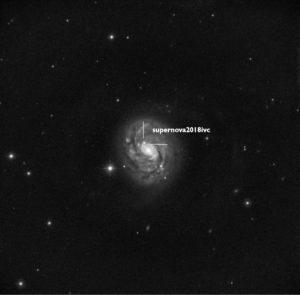
Astronomers are interested in any follow-up images of this supernova so that they can see how its light changes over time. For more information on this supernova, follow this link here: http://www.rochesterastronomy.org/sn2018/sn2018ivc.html. On this page, a list of images can be seen, along with a request for further observations – so why not get your students involved in helping these astronomers by taking some observations of this pretty galaxy a snap the supernova at the same time!
Further details can be found below.
Observing details:
Name of Galaxy: M77
Filter and exposure times: If imaging with 2m ( recommended ) use 90s with R filter, 90 Seconds with V Filter and 120 seconds with the B filter.
Coordinates: RA = 02:42:41.29 DEC = -00:00:31.71
Linked Activities:
For an introduction to plotting supernovae light curves, the FT resources site has an activity here: http://resources.faulkes-telescope.com/course/view.php?id=68
To read more about the lifecycle of stars, supernovae, and plot a lightcurve of a supernova discovered by the ESA Gaia mission, have a look here: http://resources.faulkes-telescope.com/course/view.php?id=141
To find out more about using the Real-Time interface or queue observing: follow this link: http://www.faulkes-telescope.com/observing/
Posted in News

© Faulkes Telescope Project