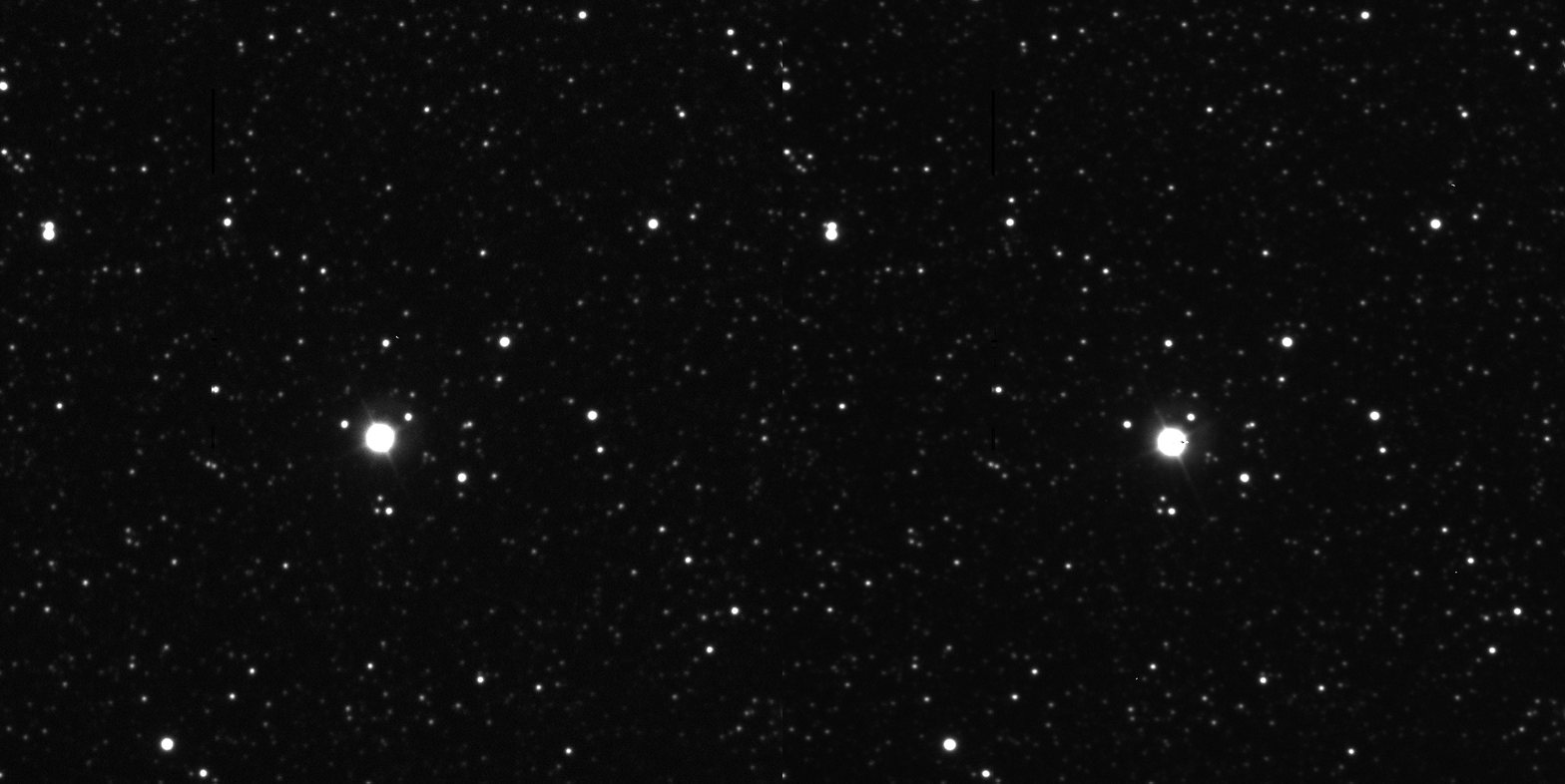
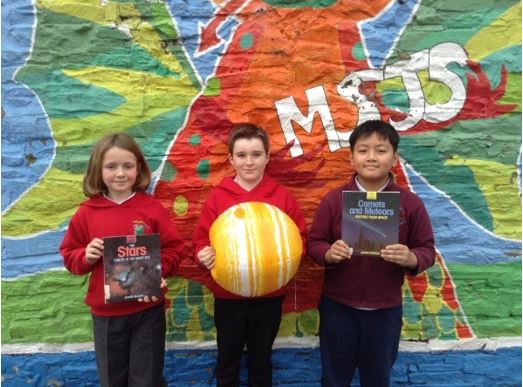
Children from four Welsh primary schools who are helping astronomers study a strange solar system object are now very excited to see their observations featured in a research paper recently published in the prestigious Astrophysical Journal.
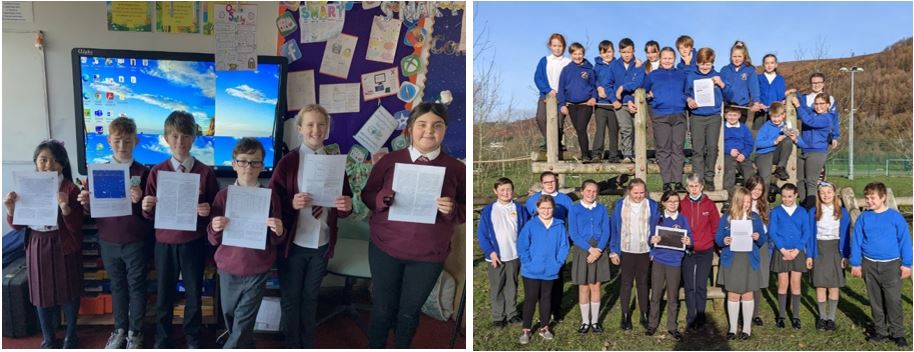
They are part of an innovative science education project called ‘Comet Chasers’ which links schools with professional comet scientists and amateur observers, around the world. Working with the Faulkes Telescope Project, schools have been observing and measuring the asteroid 2005 QN173 which developed an unusually long tail, a very rare behaviour normally only associated with an icy comet.
Children from St Mary’s Catholic Primary School in Bridgend, Ynysowen Community School, and Mount Street School in Brecon made research observations using the 2-metre Faulkes Telescope North in Hawaii. Montgomery Church in Wales School in Powys is helping with the ongoing observations. The specific observation parameters were agreed with Dr Henry Hsieh from the Planetary Science Institute in the USA, who is leading an international study of this strange object.
Dr Hsieh is the lead author on the new paper, with the Comet Chasers team as some of the co-authors. Dr Hsieh is very grateful for the data provided by the young Welsh astronomers: “The Faulkes Telescope observations collected by the Comet Chasers students really helped our study thanks to some of the unique capabilities of the telescope, and the speed of response to requests for observations”, he said. “We’re very happy to have these students and their teachers and mentors be able to make real contributions to this research and are looking forward to continuing working with Comet Chasers students in the coming year.”
Mr. Wooding is a teaching assistant at St Mary’s, Bridgend, and is a co-author on the research paper. He commented “The children at St. Mary’s Catholic Primary School are very excited to play a part in the data collection for asteroid-comet 248370. We’re very grateful to Helen Usher and the Comet Chasers project for giving our children the opportunity to undertake real science using professional astronomical equipment for the collection and analysis of important and significant data.“
The children at Ynysowen said they loved every minute of the Comet Chasers project. “Having total control of a big telescope was so much fun”. They were so excited to see the observations they have made being used for finding out more about this strange object, and particularly seeing their school’s name in the paper!
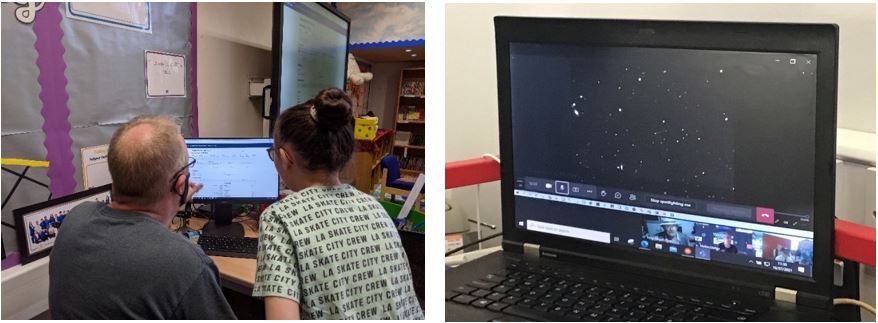
The newly published research reveals more details of this intriguing object, now re-classified as a Main Belt Comet (Comet 433P) as it shares characteristics of both a Main Belt asteroid and an icy comet. Discovered in 2005, it appeared to be a typical asteroid in the Main Belt of asteroids between Mars and Jupiter – looking like a moving, star-like point of light. But this year its appearance was completely different, as it developed a thin straight tail. Such objects are rare – only 20 have been observed so far.
These objects are interesting because a substantial part of Earth’s water is thought to have been delivered via asteroid impacts when the Earth was being formed. The observed activity of these objects means they are likely to still contain ice. They therefore offer a way to test this hypothesis and to learn more about the origins of life on Earth. We are learning more about the abundance, distribution, and physical properties of icy objects in the inner Solar System.
The research suggests that the nucleus of 433P is about 3.2 km across and is surrounded by a dust cloud. In the children’s observations, the tail was measured as over 720,000km long, but just 1,400km wide. The narrow tail tells scientists that the dust is barely floating off the nucleus at very slow speeds. The flow of gas (which usually is the cause of dust escaping a comet) is very weak, which raises questions for future study: ‘What is causing the dust to escape?’ ‘Is it a fast-rotating object flinging off material from its surface?’. The Welsh Comet Chasers are continuing to make observations, and so they will be helping to try to solve these mysteries too.
There is more excitement to come too. The Comet Chasers schools are observing other comets for different research projects, including the BAA/Richard Miles Mission 29P observing campaign. And two further research papers are already being drafted using Comet Chasers observations.
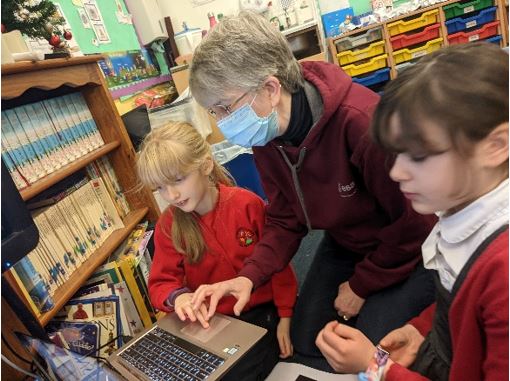
The schools also stand ready to respond quickly to requests for observations for new objects or where unusual activity is noted. Their quick access to the large telescopes of the Las Cumbres Observatory network of telescopes, through the Faulkes Telescope Project, really aids professional researchers who usually have to plan observations months in advance. The collaborations are certainly proving fruitful for everyone.
The project is about much more than just the scientific output though. The Comet Chasers team has been providing educational resources and hands-on support to teaching staff, allowing them to use the ‘Wow’ factor of space to engage and inspire learning across the curriculum. The enthusiasm of the teaching staff in each school, along with the support of BAA members, has been key to the project’s success so far.
The team would be very happy for other schools to join the Comet Chasers project too! Contact Helen Usher, helen.usher@open.ac.uk for more information.
]]>Okay, perhaps calculating the distance to your own thumb is not such an interesting activity to do, but what if you could use the same method to calculate the distance to an asteroid? That is exactly what students in Germany have been doing!
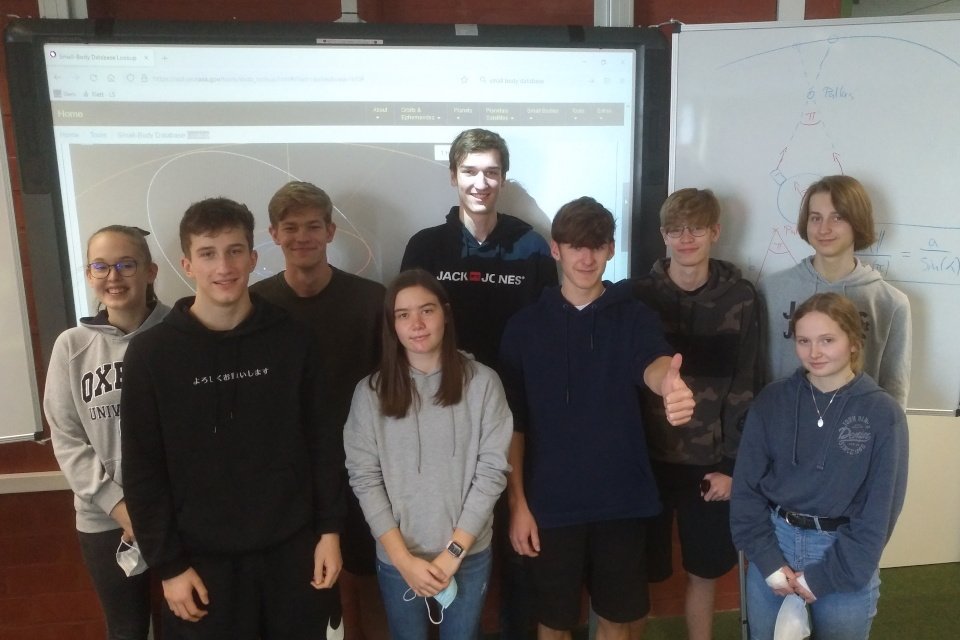
The students in Figure 1 accessed two telescopes at the same time, but at different sites within the LCO network, Cerro Tololo (Chile) and Haleakala (Hawai’i) to observe the asteroid, Pallas.
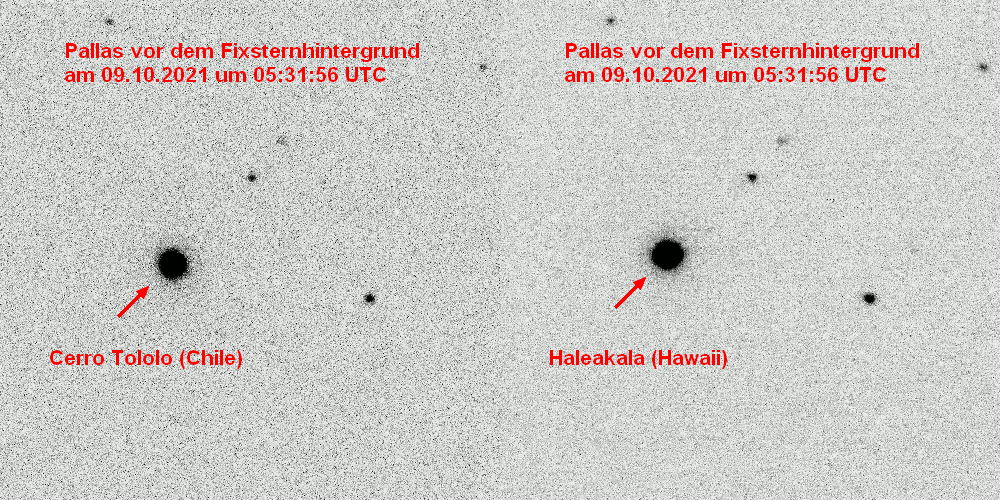
Figure 2 shows two of the students’ images where you can see how the asteroid ‘jumps’ in the field of view. The students were able to calculate the distance to Pallas within approximately 5% of the value that is recorded on NASA’s database!
You can read about their work in full here.
Thanks to Paul Breitenstein for sharing this fantastic work and story with us!
]]>Germany)
After an unsuccessful three-week search with the 1m LCO telescopes by students at Pascal-Gymnasium, Münster, comet 46P finally fell into our net with the help of the 2m FTS. And no wonder – the comet (with the beautiful name “Wirtanen”) was predicted by the MPC to reappear at magnitude ~14.6, but until now it has only reached magnitude 19.8!
Whether 46P will be seen with the naked eye by December, as predicted, is questionable. We are very excited about further development, because 46P is considered capricious. It belongs to a small family of hyperactive comets whose activity levels are higher than expected. They seem to emit more water than they should for the size of their nucleus.
That is why participation in the “Comet Wirtanen Observing
Campaign” is worthwhile! (see http://wirtanen.astro.umd.edu/)
]]>First sight on 46P/Wirtanen
After a three-week search with the 1m telescopes, the comet 46P finally went into the net with the help of the 2m FTS. No wonder! The comet with the beautiful name “Wirtanen” was announced by the MPC with 14.6mag, but until now reaches only 19.8mag. pic.twitter.com/4GoP6U3ZNh— Paul B (@PaulB37754445) July 19, 2018
 2018AM4 is an asteroid orbiting the Sun that had gone unnoticed until it was discovered by Levin, from class 9e1 of Pascal High School in Münster, Germany. The asteroid is estimated to have a diameter of almost 2 kilometers and takes 5 years to circle the Sun once. At a distance of 450,000,000 km to the Sun, it is about three times as far from the Sun as the Earth is and is part of the Main Asteroid Belt between Mars and Jupiter.
On January 6 2018, Levin first discovered 2018AM4 on images of the 2-meter Faulkes Telescope North on Mount Haleakala, Maui, Hawaii. He was able to track the object over seven more nights until January 19th, visible as a small moving point on his images. He did this all from Münster, thanks to the Faulkes Telescope Project working with the “Astronomy and internet in Münster” (AiM) group at Pascal High School.
On January 21st 2018, Levin’s discovery was accepted by the Minor Planet Center (MPC) at the Smithsonian Astrophysical Observatory in Cambridge, USA, and given the scientific name 2018AM4. This allows every astronomer in the world to mark the current position of this asteroid in their own recordings automatically, and this greatly facilitates future observations of the object.
Finally, Levin’s success was rewarded with a first place in the regional competition of “Schüler experimentieren”. On the 4th and 5th of May, Levin presented his asteroid discovery at the state competition in the House of Technology in Essen.
]]>Following an observing alert posted on April 10, four groups contributed observations of the newly-discovered near-Earth asteroid 2008 GP3 using Faulkes South. The object was imaged both on April 11 and on April 12 and photometry was performed by Richard Miles of the British Astronomical Association to check whether or not the object was a fast rotator. Since 2008 GP3 is a small object, probably only about 20-30 meters across, there is a good chance that it spins quickly on its axis. Observations by Paulet High School, Lord Wilson School, TU-Darmstadt and the BAA Asteroids and Remote Planets Section have indeed shown that the object turns quickly, completing one revolution every 11.78 minutes as shown in the image here.
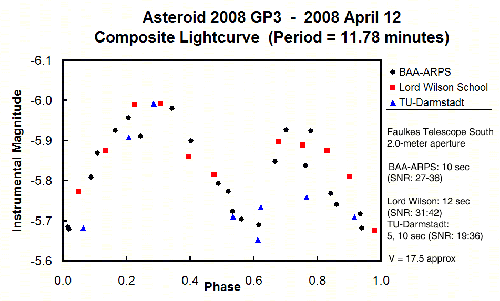
This is a first-time success for the project, which is ideally suited to schools participation using the Faulkes Telescopes. Just two or three consecutive observing sessions can reveal the presence of superfast rotators turning 360 degrees in a matter of minutes. Indeed, cooperation between observing groups is essential if asteroid rotation rates are to be identified unambiguously. Our knowledge of the near-Earth population of small asteroids is very sparse so schools can contribute directly to our understanding of these nearest neighbours of ours. We believe that most of these objects are probably fragments ejected from collisions between larger bodies which took place some time in the distant past. However, other objects may have originated when the solar nebula was formed billions of years ago. We just don’t know!
]]>Two students from Our Lady and St. Patrick’s College, Knock, and Bangor Grammar School in Northern Ireland worked with astronomers at the Armagh Observatory in January this year, observing comets and unusual asteroids. Read the report they wrote about their work here…
“The comet 169P was first observed by the Near-Earth Asteroid Tracking system. In order to observe this comet we had to figure out if it was possible to view it from Faulkes Telescope South, a 2m reflecting telescope which is used for research as well as for use by school students around the world over the internet. We found where this comet was predicted to be using the Minor Planet Center. Since 169P is such a bright object, we were able to use a red filter on some of our observations to provide a clearer image. We made five observations of the comet and could clearly see its orbital movement.
At 1400 hours on Monday 25th January we took control of the Faulkes Telescope South in Siding Spring, Australia. With the help of David and Tolis, we found that our exposure time should be at most 20 seconds, because the comet was moving quite fast. We decided 10 seconds exposure was long enough due to the comet’s bright magnitude. We managed to take 5 photographs of the comet before moving on to a new observation. In order to distinguish between a star and our comet, we had to take more than one observation of the same position and then compare the images to see if any of the supposed stars moved. In our images it was very clear where 169P was as it moved a great deal.

An animation showing the movement of 169P. Images obtained using the Faulkes Telescope South, operated by Las Cumbres Observatory.
169P was first thought to be an asteroid and was given the designation 2002EX12. After obtaining our images we made astrometric and photometric calculations and realised why this had happened. The easiest distinction to make between comets and asteroids is that asteroids are point source objects and comets are not. Most comets have comas, a visible, fuzzy atmosphere surrounding them. We compared the FWHM (Full Width Half Maximum) of our comet to the FWHM of the surrounding stars as we know that stars are point source objects. We found that our comet did have similar FWHM to the stars, showing no detectable coma and explaining why it was first classed as an asteroid.
169P is the parent body to the alpha Capricornids meteor shower. The shower can be seen from July 15th to September 11th but is best observed at the beginning of August. The shower has the reputation of producing some of the brightest meteors of the major showers, with the average magnitude being estimated as about 2.2. There was confusion over the shower’s parent body for over 50 years.
We had three more observing sessions booked for the week and hoped to make more observations of 169P/NEAT. Only two of these sessions were with Faulkes Telescope South and unfortunately both were cancelled due to bad weather. We did however get to observe five other asteroids using Faulkes Telescope North, including 21 Lutetia, an unusual main belt asteroid which will be the first M-Type asteroid passed by the European space probe Rosetta.
We had a wonderful time learning how to use the telescope and appreciate all the time that David, Tolis and everyone else at the Observatory spent helping us understand what we were doing.”
Alison Hoy (Our Lady and St. Patrick’s College, Knock, Belfast) and Ronan Smyth (Bangor Grammar School (Bangor)
]]>In January this year, 2 students from Victoria College, Belfast, worked with astronomers at the Armagh Observatory, and found a very exciting object! Read their report of their observations here…
“The asteroid 2007 UR2 hadn’t been observed in over 2 years, which means that predicting its orbit would be particularly uncertain, making this asteroid quite difficult to find. 2007 UR2 is an asteroid which has an extremely unusual horseshoe orbit associated with the planet Mars; this coupled with the lack of observations of this asteroid makes our observations even more valuable.
In order to find this asteroid we had to work out a line of prediction, rather than just taking one prediction. We found where this asteroid was predicted to be on the Minor Planet Center; however, we knew that this prediction was likely to be uncertain. We therefore decided to calculate positions 2 arc minutes and 6 arc minutes on either side of the predicted position to point the telescope, with the field of view being 4.7 arc minutes. In fact it turned out that the prediction was so uncertain that we found the asteroid in the furthest position, 7 arc minutes away from the predicted position.

Line of variation search (+ marks predicted position, O marks actual position) – Images obtained using the Faulkes Telescope North, operated by Las Cumbres Observatory
We did all this planning the day before we used the telescope, and at 10.30 am on Thursday 21st January we took control of the Faulkes Telescope North in Hawaii. Once we had finished our observing session, which was a little stressful seeing as we had never used a telescope before and had only half an hour to take 8 photographs. With the help of David and Tolis, timing that it took us exactly 3 minutes to take each photograph, we managed to take 9 photographs, taking three exposures of the last position, which incidentally turned out to be where our asteroid was.
In order to distinguish between a star and our asteroid, we had to take two images of the same position and then compare the two images to see if any of the apparent stars moved. The only way to tell the difference between the asteroid and a star is that the asteroid will move, and in order to tell if it is the asteroid we want we need to check if the asteroid was moving in the right direction from the predictions. When we looked at our images, after a quick tea break and a calm down after using the telescope, we realised that we had found two asteroids from our observations. We thought, for a short period of time, that we might have actually found a new asteroid. However, David quickly stole our thunder, by working out that it was actually a known main belt asteroid (94020). Nonetheless, our observations were still very successful, as we worked out that the other asteroid was indeed 2007 UR2, the asteroid that we were looking for.

Images obtained using the Faulkes Telescope North, operated by Las Cumbres Observatory. Animation compiled by Apostolos Christou
In order to report our sightings to the Minor Planet Center, to improve predictions of the asteroid’s orbit, we had to observe the asteroid again. So we spent the rest of the afternoon working out the exact location of the asteroid in our images, and then comparing it to the prediction. We then knew by how much the predicition was out and therefore could work out exactly were the asteroid would be. So, on Friday 22nd January at 10.00 am, we took control of Faulkes Telescope North, and pointed the telescope where we had newly predicted our asteroid to be, and sure enough there it was. We now had enough information to send our observations to the Minor Planet Center.
When using the telescope on the second day we also had a chance to view some other interesting objects. We observed 2010AH30, a near Earth asteroid, and 2009 YS6, a damocloid. These observations were also sent to the Minor Planet Center.
We had such an amazing time taking control of the telescope, and we honestly cannot believe that we actually recovered an asteroid, in 3 days of work experience at the Armagh Observatory. We would like to say a huge thank you to everyone at the Observatory, especially David Asher and Apostolos Christou, without whom we would have been completely lost, and confused.”
Catherine O’Prey and Christina Larkin (Victoria College, Belfast)
]]>On Tuesday May 18th, pupils at College Le Monteil in France, together with their teacher Andre Debackere, used FTS to image two of the dwarf planets in our Solar System – Pluto and Ceres.
The images of Pluto, taken with the R filter for 30s were then made into an animted gif, shown below. Pluto can clearly be seen near the middle of the image, moving against the starry background.
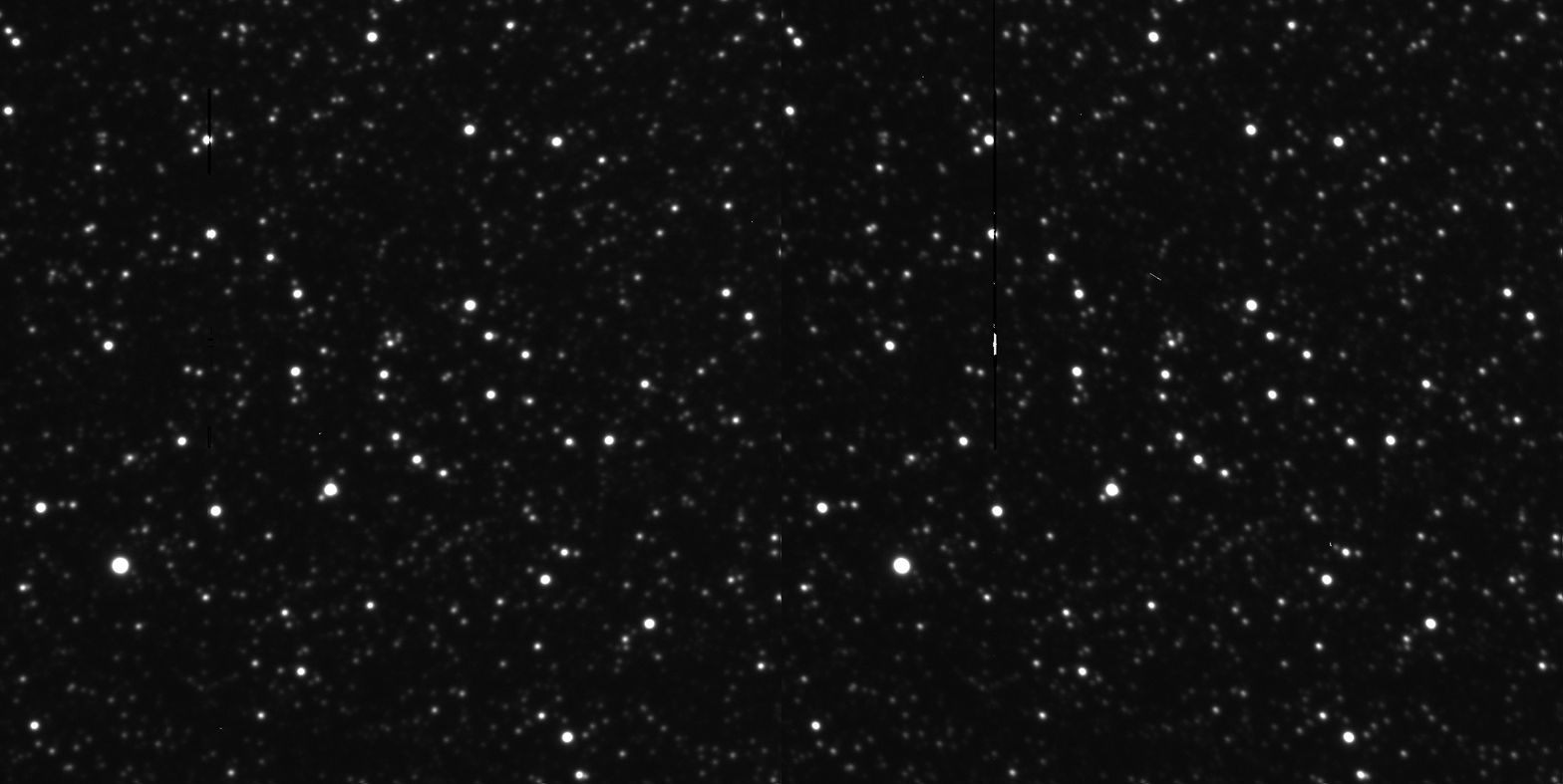
Also shown below is the school’s animated gif of Ceres, the smallest known dwarf planet in our Solar System, taken with a 5s exposure using the R filter on FTS. Ceres is very obvious near the centre of the image!