-
Faulkes Telescope Project Privacy Policy
Discovery of fast rotating asteroid
Paulet High school, Lord Wilson High School, UK
Following an observing alert posted on April 10, four groups contributed observations of the newly-discovered near-Earth asteroid 2008 GP3 using Faulkes South. The object was imaged both on April 11 and on April 12 and photometry was performed by Richard Miles of the British Astronomical Association to check whether or not the object was a fast rotator. Since 2008 GP3 is a small object, probably only about 20-30 meters across, there is a good chance that it spins quickly on its axis. Observations by Paulet High School, Lord Wilson School, TU-Darmstadt and the BAA Asteroids and Remote Planets Section have indeed shown that the object turns quickly, completing one revolution every 11.78 minutes as shown in the image here.
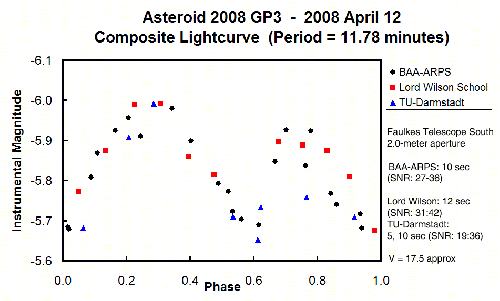
This is a first-time success for the project, which is ideally suited to schools participation using the Faulkes Telescopes. Just two or three consecutive observing sessions can reveal the presence of superfast rotators turning 360 degrees in a matter of minutes. Indeed, cooperation between observing groups is essential if asteroid rotation rates are to be identified unambiguously. Our knowledge of the near-Earth population of small asteroids is very sparse so schools can contribute directly to our understanding of these nearest neighbours of ours. We believe that most of these objects are probably fragments ejected from collisions between larger bodies which took place some time in the distant past. However, other objects may have originated when the solar nebula was formed billions of years ago. We just don’t know!
Posted in Schools

© Faulkes Telescope Project