HOYS was a successful LCO Global Sky Partner last year, working with amateur astronomers on long-term photometric monitoring of young stellar clusters to find outbursting and other interesting objects for detailed follow up as well as the study of star and planet formation processes. This year, they are expanding their project to involve schools in this exciting research area, and aswell as access to the LCO 0.4m telescopes, eligible schools will be able to access the 2m Faulkes Telescopes through the Faulkes Telescope Project.
More information, including an application form can be found on the HOYS website – this would be a great project to start the school year with so have a look and be prepared to join a project that’s out-of-this-world!

By Mika Wawerzonnek
Mika Wawerzonnek, A 17-year-old 11th grade student studying at Ratsgymnasium Münster in Germany has been using the telescope network to complete his term paper (German: “Facharbeit”). The title of Mika’s paper translates to “Identification, Confirmation and Trajectory Tracking of Near-Earth Objects – Threats from the Cosmos”.
As part of his project, Mika has had intense involvement in the discovery of Near-Earth Objects (NEOs). Mika completed his observations using the Faulkes Telescopes and LCO network and analysed his observations using Astrometrica, a software which focuses on measuring small bodies in our Solar System, such as asteroids, comets and dwarf planets.
Mika then submitted his data to the Minor Planet Center (MPC) that is part of the Smithsonian Astrophysical Observatory (SAO). The MPC publishes a Near-Earth Object Confirmation Page and a Possible Comet Confirmation Page. Mika selected objects from these pages that were waiting to be confirmed as an NEO or discarded as a false report.
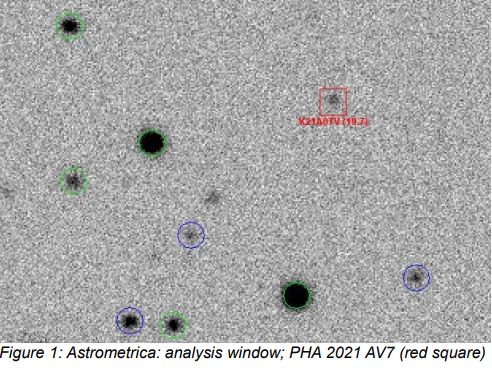
Throughout the duration of his project, Mika submitted approximately 30 MPC reports, 14 of which were confirmed as NEOs and Mika was mentioned in the Minor Planet Electronic Circulars that list the first observers who confirm the object until an official designation is assigned by the MPC. A list of the MPECs that Mika contributed to is provided at the end of this article.
Mika’s paper and numerous observations were invaluable, expanding the MPC data pool and assisting in making accurate predictions of orbits, thus helping to direct potentially dangerous objects.
Paul Breitenstein, one of Mika’s mentors commented: “Nowhere is it quicker and more impressive to see that space is dynamic than when observing asteroids and comets. With his work, Mika was able to actively participate in clearing the pathways of two minor planets, which were temporarily on the ESA’s Risk List.”
The fantastic report has been nominated for the Dr Hans Riegel Competition that aims to honours scientific work completed by upper secondary school students. Good luck, Mika!
List of Mika’s contributions and relevant webpages:
1) MPEC 2020-Y113 : 2020 YN3
https://www.minorplanetcenter.net/mpec/K20/K20YB3.html
2) MPEC 2021-A24 : 2021 AL
https://www.minorplanetcenter.net/mpec/K21/K21A24.html
3) MPEC 2021-A27 : 2021 AO
https://www.minorplanetcenter.net/mpec/K21/K21A27.html
4) MPEC 2021-A39 : 2021 AA1
https://www.minorplanetcenter.net/mpec/K21/K21A39.html
5) MPEC 2021-A99 : COMET C/2021 A1 (Leonard)
https://minorplanetcenter.net/mpec/K21/K21A99.html
6) MPEC 2021-A165 : 2010 AJ30
https://www.minorplanetcenter.net/mpec/K21/K21AG5.html
7) MPEC 2021-A195 : COMET C/2020 Y3 (ATLAS)
https://www.minorplanetcenter.net/mpec/K21/K21AJ5.html
8) MPEC 2021-A207 : COMET C/2021 A4 (NEOWISE)
https://www.minorplanetcenter.net/mpec/K21/K21AK7.html
9) MPEC 2021-B45 : 2021 AV7
https://www.minorplanetcenter.net/mpec/K21/K21B45.html
10) MPEC 2021-A210 : COMET C/2021 A6 (PANSTARRS)
https://minorplanetcenter.net/mpec/K21/K21AL0.html
11) MPEC 2021-A211 : COMET C/2021 A7 (NEOWISE)
https://minorplanetcenter.net/mpec/K21/K21AL1.html
12) MPEC 2021-B72 : 2021 BR1
https://www.minorplanetcenter.net/mpec/K21/K21B72.html
13) MPEC 2021-B119 : COMET C/2021 A9 (PANSTARRS)
https://www.minorplanetcenter.net/mpec/K21/K21B72.html
14) MPEC 2021-B120 : COMET C/2021 B2 (PANSTARRS)
https://minorplanetcenter.net/mpec/K21/K21BC0.html
15) MPEC 2021-C19 : 2021 AW11
https://www.minorplanetcenter.net/mpec/K21/K21C19.html
C/2020 S4 (PANSTARRS) is the scientific name of a newly discovered comet, which teachers were able to confirm during their teacher training workshop at the Pascal Gymnasium Münster, Germany.
C/2020 S4 (PANSTARRS) is classified as a Jupiter family comet, and was discovered by the Pan-STARRS 1 telescope (located near FT North on Maui) on September 16th 2020. This completely robotic telescope scans the sky for moving objects every clear night. Of particular interest are near-earth objects and comets that are collected and published by the Minor Plant Center (MPC) at Harvard-Smithsonian Center for Astrophysics.
“But a discovery without independent confirmation has no scientific value!” explains Paul Breitenstein (Astronomy and internet in Münster, AiM), who organised a teacher training workshop at the Pascal-Gymnasium, Münster, Germany on 25th September 2020. The workshop introduced teachers to the robotic telescope facilities available to them, with a particular focus on the Faulkes Telescope Project, which Paul has been working with for many years.

The Münster teachers who attended the AiM workshop in September 2020 and helped to confirm the existence of C/2020 S4 (PANSTARRS).
To help with the search for independent confirmation, the nine teachers at this workshop looked at images made the day before following requests from AiM for observations with the 2m Faulkes Telescope South in Siding Spring, Australia – and they found what they were looking for!
A small point of light was seen moving through the eight images taken near the predicted position of the comet, in the constellation of Eridanus. The measured values were immediately reported to the Minor Planet Center by email, and just minutes later were used by the Harvard scientists to improve the predicted position and orbit of the comet.
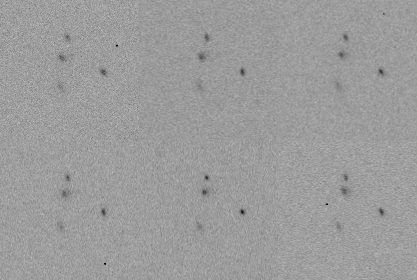
Animation showing the motion of comet C/2020 S4 (PANSTARRS) between the 8 FTS images obtained by AiM for the teacher training workshop.
The object was recognized by the MPC as a new comet only after nine other international teams had confirmed its existence, and on September 28th, 2020 it was named as comet C / 2020 S4 (PANSTARRS) with a Minor Planet Electronic Circular MPEC 2020-S239, and assigned to the Jupiter family.
“Astronomy in school needs an upgrade” Paul Breitenstein is certain. In the new Physics curriculum of the German state of North Rhine-Westphalia, astronomy is given a new status, but knowledge of new digital possibilities for schools has generally remained in the 20th century.
This is where the AiM teacher training workshop “Astronomy 2.0” comes in. With the help of AiM, teachers in Münster and nearby have learned how to access large research telescopes with their students. These 21st century digital opportunities open the possibility for school students to participate in current scientific work and make small contributions, e.g. in the discovery of asteroids or comets.
]]>Our publications are
“A 420-day X-ray/optical modulation and extended X-ray dips in the short-period transient Swift J1753.5-0127” (Charles et al., MNRAS)
“Up and Down the Black Hole Radio/X-Ray Correlation: The 2017 Mini-outbursts from Swift J1753.5-0127” (Plotkin et al., ApJ)
“Bright Mini-outburst Ends the 12 yr Long Activity of the Black Hole Candidate Swift J1753.5─0127” (Zhang et al., ApJ)
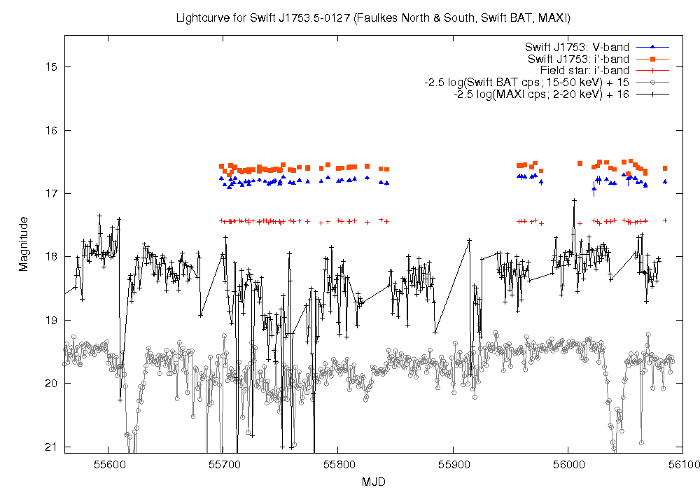
Long-term light curve for the XRB, Swift J1753.5-0127 (2011 – 2012)
Click here to return to the main XRB page
]]>As part of a wider investigation of evolved massive stars in Galactic open clusters, we have spectroscopically identified three candidate classical Cepheids in the little-studied clusters Berkeley 51, Berkeley 55 and NGC 6603.
Using new multi-epoch photometry, we confirm that Be 51 #162 and Be 55 #107 are bona fide Cepheids, with pulsation periods of 9.83+/-0.01 d and 5.850+/-0.005 d respectively, while NGC 6603 star W2249 does not show significant photometric variability. Using the period-luminosity relationship for Cepheid variables, we determine a distance to Be 51 of 5.3(+1.0,-0.8) kpc and an age of 44(+9,-8) Myr, placing it in a sparsely-attested region of the Perseus arm. For Be 55, we find a distance of 2.2+/-0.3 kpc and age of 63(+12,-11) Myr, locating the cluster in the Local arm. Taken together with our recent discovery of a long-period Cepheid in the starburst cluster VdBH222, these represent an important increase in the number of young, massive Cepheids known in Galactic open clusters.
We also consider new Gaia (data release 2) parallaxes and proper motions for members of Be 51 and Be 55; the uncertainties on the parallaxes do not allow us to refine our distance estimates to these clusters, but the well-constrained proper motion measurements furnish further confirmation of cluster membership. However, future final Gaia parallaxes for such objects should provide valuable independent distance measurements, improving the calibration of the period-luminosity relationship, with implications for the distance ladder out to cosmological scales.
Read the preprint here
]]>We characterized the broad-band X-ray spectra of Swift J1745-26 during the decay of the 2013 outburst using INTEGRAL ISGRI, JEM-X and Swift XRT. The X-ray evolution is compared to the evolution in optical and radio. We fit the X- ray spectra with phenomenological and Comptonization models. We discuss possible scenarios for the physical origin of a ~50 day flare observed both in optical and X- rays ~170 days after the peak of the outburst. We conclude that it is a result of enhanced mass accretion in response to an earlier heating event. We characterized the evolution in the hard X-ray band and showed that for the joint ISGRI-XRT fits, the e-folding energy decreased from 350 keV to 130 keV, while the energy where the exponential cut-off starts increased from 75 keV to 112 keV as the decay progressed.We investigated the claim that high energy cut-offs disappear with the compact jet turning on during outburst decays, and showed that spectra taken with HEXTE on RXTE provide insufficient quality to characterize cut-offs during the decay for typical hard X-ray fluxes. Long INTEGRAL monitoring observations are required to understand the relation between the compact jet formation and hard X-ray behavior. We found that for the entire decay (including the flare), the X-ray spectra are consistent with thermal Comptonization, but a jet synchrotron origin cannot be ruled out.
Paper here
]]>Context. Edge-on galaxies can offer important insights in galaxy evolution as they are the only systems where the distribution of the different components can be studied both radially and vertically. The HEROES project was designed to investigate the interplay between the gas, dust, stars and dark matter (DM) in a sample of 7 massive edge-on spiral galaxies.
Aims. In this second HEROES paper we present an analysis of the atomic gas content of 6 out of 7 galaxies in our sample. The remaining galaxy was recently analysed according to the same strategy. The primary aim of this work is to constrain the surface density distribution, the rotation curve and the geometry of the gas disks in a homogeneous way. In addition we identify peculiar features and signs of recent interactions.
Methods. We construct detailed tilted-ring models of the atomic gas disks based on new GMRT 21-cm observations of NGC 973 and UGC 4277 and re-reduced archival HI data of NGC 5907, NGC 5529, IC 2531 and NGC 4217. Potential degeneracies between different models are resolved by requiring a good agreement with the data in various representations of the data cubes.
Results. From our modelling we find that all but one galaxy are warped along the major axis. In addition, we identify warps along the line of sight in three galaxies. A flaring gas layer is required to reproduce the data only for one galaxy, but (moderate) flares cannot be ruled for the other galaxies either. A coplanar ring-like structure is detected outside the main disk of NGC 4217, which we suggest could be the remnant of a recent minor merger event. We also find evidence for a radial inflow of 15 +- 5 km/s in the disk of NGC 5529, which might be related to the ongoing interaction with two nearby companions.
Read the paper here
]]>On 2015 June 15 the burst alert telescope (BAT) on board Swift detected an X-ray outburst from the black hole transient V404 Cyg. We monitored V404 Cyg for the last 10 years with the 2-m Faulkes Telescope North in three optical bands (V, R, and i′). We found that, one week prior to this outburst, the optical flux was 0.1–0.3 mag brighter than the quiescent orbital modulation, implying an optical precursor to the X-ray outburst. There is also a hint of a gradual optical decay (years) followed by a rise lasting two months prior to the outburst. We fortuitously obtained an optical spectrum of V404 Cyg 13 hours before the BAT trigger. This too was brighter (~ 1 mag) than quiescence, and showed spectral lines typical of an accretion disk, with characteristic absorption features of the donor being much weaker. No He II emission was detected, which would have been expected had the X-ray flux been substantially brightening. This, combined with the presence of intense Hα emission, about 7 times the quiescent level, suggests that the disk entered the hot, outburst state before the X-ray outburst began. We propose that the outburst is produced by a viscous-thermal instability triggered close to the inner edge of a truncated disk. An X-ray delay of a week is consistent with the time needed to refill the inner region and hence move the inner edge of the disk inwards, allowing matter to reach the central BH, finally turning on the X-ray emission.
Read the preprint here
]]>We study in detail the evolution of the 2015 outburst of GS 1354-64 (BW Cir) at optical, UV and X-ray wavelengths using Faulkes Telescope South, SMARTS and Swift. The outburst was found to stay in the hard X-ray state, albeit being anomalously luminous with a peak luminosity of LX> 0.15 LEdd, which could be the most luminous hard state observed in a black hole X-ray binary. We found that the optical/UV emission is tightly correlated with the X-ray emission, consistent with accretion disc irradiation and/or a jet producing the optical emission. The X-ray spectra can be fitted well with a Comptonisation model, and show softening towards the end of the outburst. In addition, we detect a QPO in the X-ray lightcurves with increasing centroid frequency during the peak and decay periods of the outburst. The long-term optical lightcurves during quiescence show a statistically significant, slow rise of the source brightness over the 7 years prior to the 2015 outburst. This behaviour as well as the outburst evolution at all wavelengths studied can be explained by the disc instability model with irradiation and disc evaporation/condensation.
Read the preprint here
]]>We present the results of our analysis of new optical, ultraviolet (UV) and X-ray observations of a highly variable source − AX J1549.8−5416. Both the detection of several fast rise, exponential decay outbursts in the optical light curve and the lack of He II emission lines in the optical spectra suggest AX J1549.8−5416 is a cataclysmic variable of the dwarf nova (DN) type. The multiwavelength analysis of three mini-outbursts and one normal outburst represent one of the most complete multiwavelength studies of a DN and help to refine the relationship between the X-ray, UV and optical emission in this system. We find that the UV emission is delayed with respect to the optical by 1.0−5.4 days during the rising phase of the outburst. The X-ray emission is suppressed during the peak of the optical outburst and recovers during the end of the outburst. From our analysis of archival Swift, Chandra and XMM-Newton observations of AX J1549.8−5416, we estimate this DN has a high duty cycle (∼50%), suggesting a quiescent X-ray luminosity larger than 10^32 erg/s. We also find the X-ray and UV flux are roughly anti-correlated. Furthermore, we find that, at low X-ray fluxes, the X-ray spectrum is well described by a single temperature thermal plasma model, while at high X-ray fluxes, an isobaric cooling flow model also works. We find that the maximum temperature of the plasma in quiescence is significantly higher than that in outburst.
Read the preprint here
]]>