A secondary school in Oradea, Romania has taken some wonderful images using the Faulkes Telescopes and LCO Network. One of their physics teachers, Valentina Matei shared their story with us:
I teach physics for 12-14 years old students at “Dacia” Secondary School in Oradea, Romania. I teach Astronomy in extracurricular activities for 13 years old students in my school. I love astronomy and space science, so I took part in professional development programs in this domain. I also participated at “Honeywell Educators at Space Academy” program in July 2008 and 2011 (advanced level) at U.S. Space & Rocket Center in Huntsville, Alabama, USA, and “Astronomy Education Adventure in the Canary Islands”, July 2020 (online).
I use interdisciplinary teaching in order to increase students’ motivation and learning for science. Astronomy is part of our culture’s history and roots. For us, to study deep-sky objects as galaxies, nebula, star clusters, using high level telescopes from Hawaii and Australia, in the Faulkes Telescope Project is a dream come true.
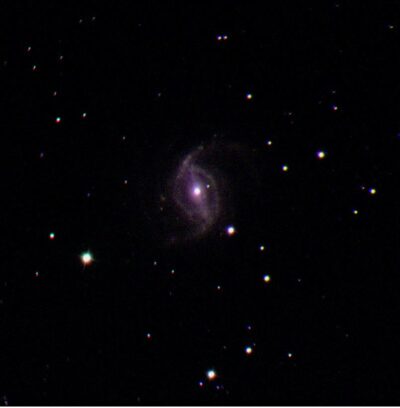
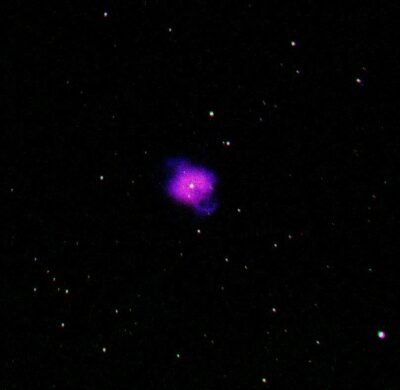
We tool pictures of galaxies, a nebula and star cluster. We used SalsaJ to display, analyse and explore these images. Our favourite picture is M47.
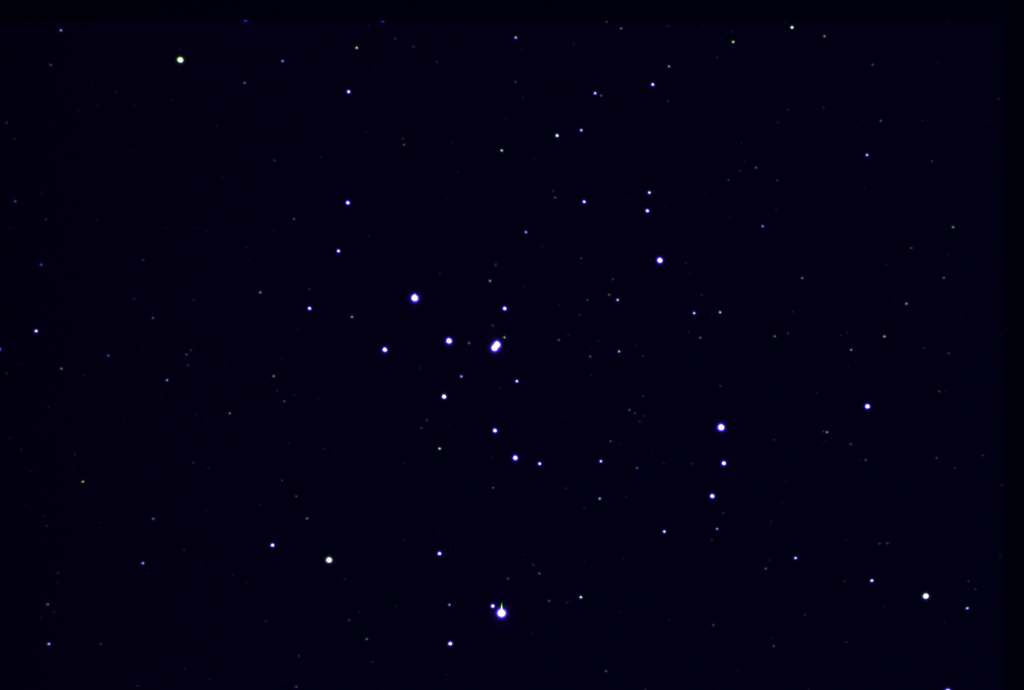
Studying the structure of our Galaxy is a challenging task. One of the ways to investigate the Galactic structure is through studying the properties of various classes of objects that populate the Galaxy. The formation and evolution of the Galaxy can be probed through open star clusters, which are groups of stars that formed from the same molecular cloud and have roughly the same age, distance and chemical composition.
Messier 47 (M47 or NGC 2422) is one of the least densely populated open clusters, located approximately 1600 light-years from our solar system, in the southern constellation of Puppis. The open cluster began their life around 78 million years ago and now cruising away from our solar system at a speed of 9 kilometres per second. An open cluster presents an opportunity for observing star colours. The blue colour of the brightest stars is an indicator of their temperature, with hotter stars appearing bluer and cooler stars appearing redder. The brightest stars of this cluster are spectral class B2 and magnitude 5.7. It also contains two orange K giants with luminosity of about 200 times that of the Sun.
The bright star nearest to the centre of Figure 2 is the fine double star, Sigma 1121 with components of magnitude both 7.8 and separated by 7.4 arc seconds.
Thank you for the opportunity to join this amazing project in order to discover the Universe!
________________________________________________
The Astronomy Education Adventures in the Canary Islands will be taking place again next year, this time in Tenerife! To find out more information and how to apply, visit the website here.
]]>A photometric study of the open cluster M25 has been conducted by Mrs. Stella Tryfonidou and her class of 10th grade students. Their work is presented in both Greek and English and features a study of stars and stellar evolution.
By using images from the LCOGT archive, they were able to use the free photometry package, Salsa J, to take measurements of the brightness of several stars and use these to create a colour-magnitude diagram.
From this, they were able to identify a main sequence of stars as well as identifying a star which may be an evolved red giant.
The students have clearly enjoyed this study which has allowed them to gain an understanding of how research is conducted as well as being able to produce a well-written report in both their own language and in English.
