
Via our parent organisation, the Dill Faulkes Educational Trust (DFET), we at the Faulkes Telescope Project are proud to lead an EU Erasmus+ project called LaSciL.
LaSciL stands for Large Scientific infrastructures enriching online and digital Learning and aims to support high quality science teaching, through the use of data archives and innovative online tools.
With our partners in Greece, Portugal and Austria, we will aim to support teachers to use these tools to:
- create educational resources for students in open and distance learning;
- manage large numbers of students in an online environment and keep them motivated to participate;
- personalise teaching practices based on students’ needs.
For UK-based teachers, we are looking to conduct some ‘multiplier’ events in the next few months, either face-to-face or online. Here, we will be able to demonstrate resources based primarily around robotic telescopes but also showcasing our colleagues’ work in their specialist areas. Our online events will also be available to attend (for free) for teachers and educators wherever they are in the world.
Please contact us for more details by emailing fraser.lewis (at) faulkes-telescope.com
As with many EU projects, LaSciL will run a couple of ‘summer schools’. This year, it will be from July 3 to 8 in Heraklion, Crete and next year, it will take place in Portugal. We have funding to provide UK teachers with flights and accommodation for these weeklong trips so if you’re interested, please contact us.
More details can be found here for the project (https://lascil.eu/) and the summer school (https://esia.ea.gr/lascil-summer-school/).


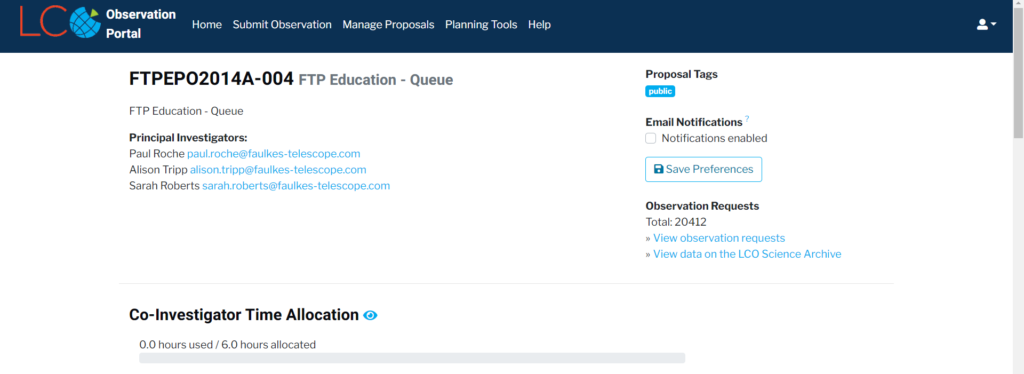
LCO has recently released a very useful feature for our registered users. All users (LCO call us Co-Investigators or CoIs) on our queue-scheduled proposal are now able to see how much time they have been allocated in the current 6 month semester and how much of this time they have already used.
From the main observing page, simply click on ‘Manage Proposals’ and you’ll see it shown under ‘Co-Investigator Time Allocation’. In the example shown here, this CoI has used none of their allocated 6 hours for this semester.
What do I need to do?
If you can help then it is best to take exposures of 60 seconds duration using all three filters (red, green and blue), in a sequential manner on the 2m telescopes. If you can take 10 frames then that should be sufficient.
On the 1m telescopes, please take single 120 s exposures with g’ and i’ and then a series of 120 s exposures through r’ to go deep into the outburst coma.
Anything else?
If you have time afterwards then please repoint the telescope to Comet 17P/Holmes and take as many 120 seconds duration exposures again using all 3 filters. Comet 17P is famous for an outburst that happened in 2007 when it became 400,000 times brighter than normal. Maybe it will have another outburst whilst you are observing! It’s last one was this August.
Where is Comet 29P/S-W1?
The daily positions for Comet 29P can be found on our monthly targets page.
Step-by-step instructions
1. For the target, use the name ” 29P ” (or ” 17P ” see below)
2. Enter the RA position. For September 30 and 29P this would be ” 04 57 45 ”
3. Enter the Dec position. For September 30 and 29P this would be ” +31 52 53 ”
N.B. You will need to look at the URL to select the actual RA and Dec positions for the day you wish to observe the comet.
4. Now tick the box for ALL three filters and in the exposure time line , enter ” 60 ” for each of them
5. When the ‘Go’ button lights up bright green then click on it and wait. In the top right of your screen you will see what the telescope is doing as well as the countdown clocks. When the image(s) have been taken and saved, the ‘Go’ button will light up green again so just click on it and repeat the series for a total of 10 exposures.
If you have time, please repoint the telescope and repeat the exercise but this time looking at Comet 17P and using the name ” 17P ”
N.B. You can be filling in the new name, positions and exposure times even whilst the telescope is taking an exposure
Use exposure times of ” 120 ” seconds for each filter.
The positions of Comet 17P to point the telescope at are given in the table below (depending on which day you are observing):
Date RA Dec
Sep 30 05 50 51 +45 09 04
Oct 1 05 51 38 +45 15 11
Oct 2 05 52 23 +45 21 17
Oct 3 05 53 06 +45 27 22
Oct 4 05 53 47 +45 33 27
Oct 5 05 54 26 +45 39 31
Oct 6 05 55 03 +45 45 35
Oct 7 05 55 38 +45 51 37
Oct 8 05 56 11 +45 57 39
Oct 9 05 56 42 +46 03 39
Oct 10 05 57 11 +46 09 39
Oct 11 05 57 38 +46 15 37
If you’d like to take part, more information is here and registration is available until 15th October from this link
]]>HOYS was a successful LCO Global Sky Partner last year, working with amateur astronomers on long-term photometric monitoring of young stellar clusters to find outbursting and other interesting objects for detailed follow up as well as the study of star and planet formation processes. This year, they are expanding their project to involve schools in this exciting research area, and aswell as access to the LCO 0.4m telescopes, eligible schools will be able to access the 2m Faulkes Telescopes through the Faulkes Telescope Project.
More information, including an application form can be found on the HOYS website – this would be a great project to start the school year with so have a look and be prepared to join a project that’s out-of-this-world!
Yesterday (19th July 2021), at the Royal Astronomical Society’s National Astronomy Meeting, Open University PhD student Helen Usher presented details of the work undertaken by a group of primary schools in South Wales to observe and measure an asteroid which has developed an unusual long tail – very rare behaviour normally only associated with an icy comet.
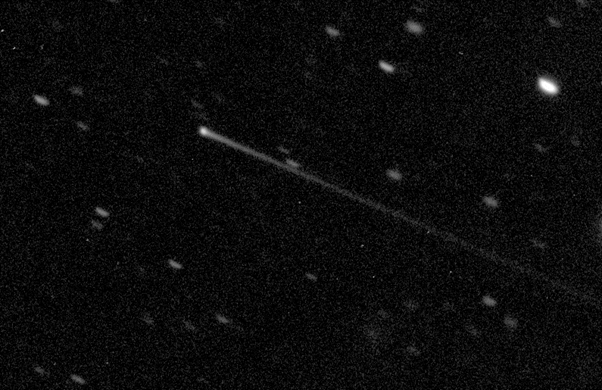
Asteroid 2005 QN173 recently began to develop a tail and is being studied with great interest by professional and amateur astronomers around the globe.
Pupils from three primary schools (St Mary’s Catholic Primary School, Bridgend; Ynysowen Community School, and Mount Street School, Brecon) are part of the ‘Comet Chasers’ project, funded by the Science and Technology Facilities Council (STFC) and led by the Faulkes Telescope Project (FTP) with the Techniquest science discovery centre. The pupils set up remote observations with the 2-metre Faulkes Telescope North in Hawaii.
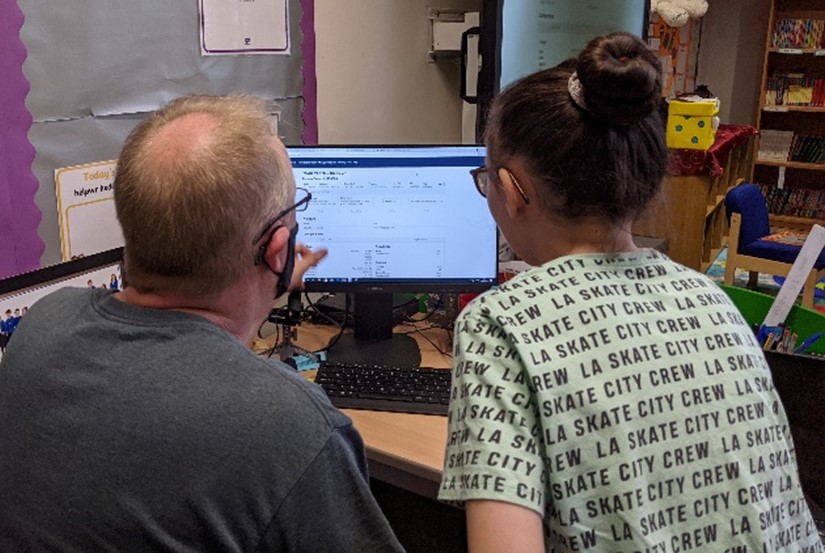
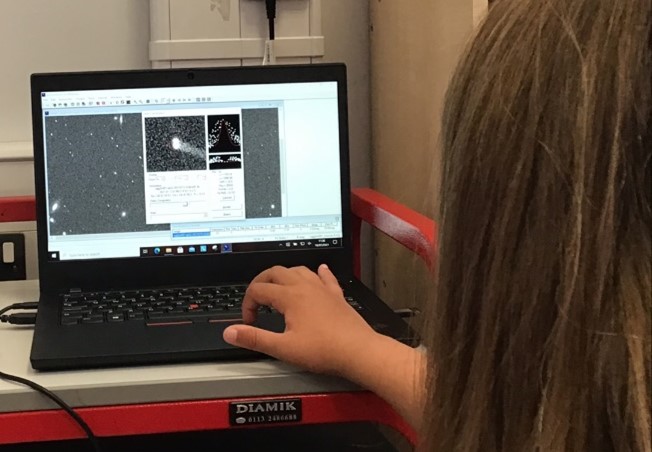
With help and guidance from Tony Angel and Richard Miles (Royal Astronomical Society and British Astronomical Association) and their teaching assistant, amateur astronomer Ben Wooding, the pupils from St Marys school analysed the images to measure the position of the asteroid and its brightness.
Measurements were then sent to the Minor Planets Center in the USA, which calculates the orbits of asteroids and comets and monitors their activity. The children were very excited about being able to help astronomers study this bizarre object!
These measurements were submitted less than a week after the global comet community was asked to make observations to help study this highly unusual object.
“Comet Chasers is exactly the sort of thing the Faulkes Telescope Project was set up to do – we can put school pupils in direct control of a multi-million-pound telescope and, with the guidance of keen amateur and professional astronomers, they can really help contribute to astronomical research – and have great fun at the same time!” said Prof. Paul Roche, the Director of the Faulkes Telescope Project and an astronomer at Cardiff University.
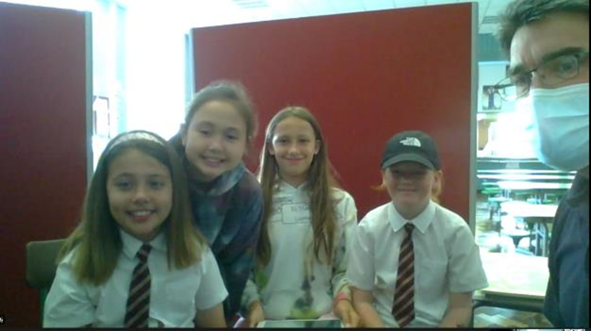
Tony Angel, an amateur astronomer now based in Spain commented: “I have always enjoyed being involved in Pro-Am projects like this. Comet Chasers is about passing our knowledge on and bringing the wonders of astronomy to children. I think this is a very important role for us as RAS Fellows. Hopefully it will lead to some of these children becoming astronomers!”.
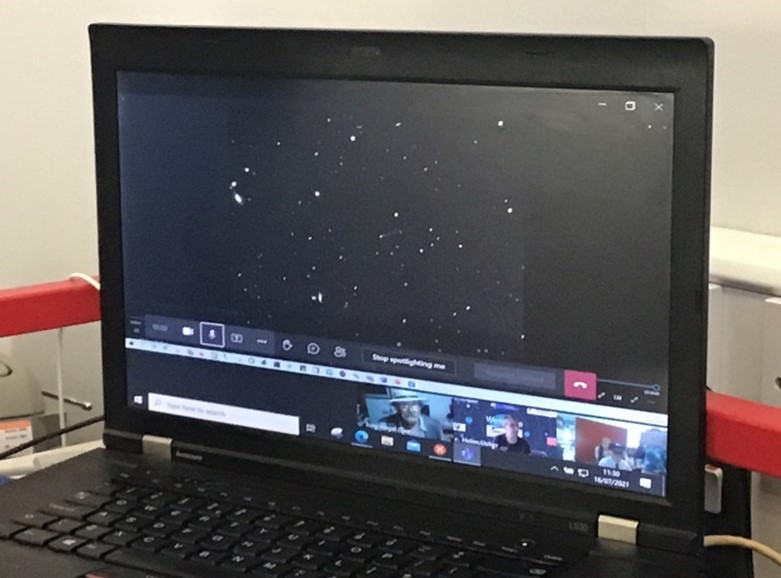
Helen Usher, a PhD student at the Open University studying Rosetta’s Comet (67P), added: “It has been fantastic to lead the Comet Chasers project working with the Faulkes Telescope Project. I have really enjoyed bringing real comet science, my love of the Rosetta Mission, and the wonder of astronomy, to over 100 primary school children in my local area. I am particularly pleased that schools are keen to carry on in the next school year. Comet 67P gets close to the Sun again in early November 2021, so I’m looking forward to schools helping my research by observing, measuring and monitoring it with me through the Autumn.”
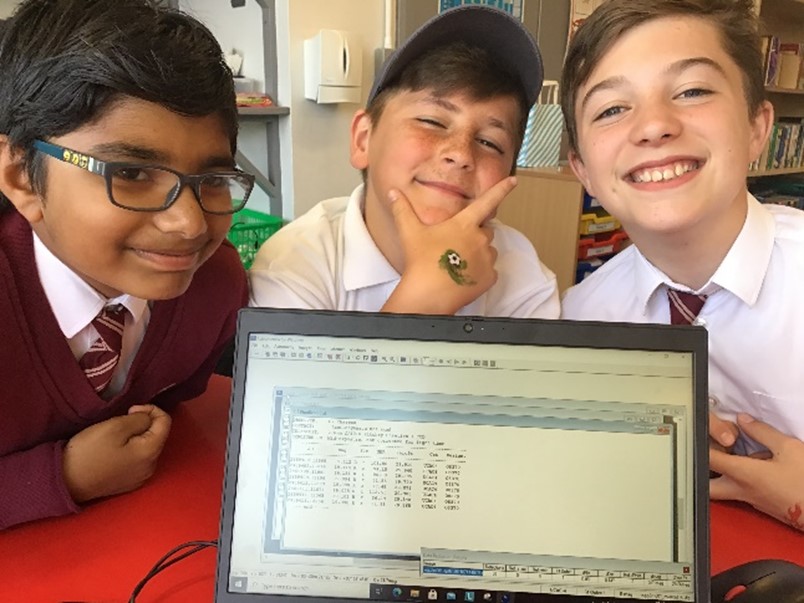
Background – the asteroid with a tail:
An object originally discovered in 2005 as a main-belt asteroid has very recently been found to be displaying a comet-like tail, one that is unusually long and straight. Found by Nicolas Erasmus of the South African Astronomical Observatory whilst inspecting ATLAS survey images taken from Haleakala, Hawaii, 2005 QN173 represents a very rare class of object, the true nature of which is yet to be identified.
Prof. Alan Fitzsimmons, one of the ATLAS team, has commented that this active asteroid might belong to a group of objects termed the ‘main-belt comets’ (MBCs) given that its orbit is similar to that of an MBC and that it has become active near perihelion. However, there is no evidence of a secondary tail indicative of cometary volatiles and so we may be looking at an asteroid that has been disrupted by collision with some smaller body, or through its spin rate gradually increasing until it exceeds the disruption limit whereby self-gravity and cohesive strength are not sufficient to hold itself together.
The exciting finding on images taken on 2021 July 7.6 was reported by Prof. Fitzsimmons on a note to mailing lists on comets and minor planets on July 9 and Helen Usher of Comet Chasers was able to request observations on 1.0-m and 2.0-m telescopes the same day using the Las Cumbres Observatory network. In fact, the first images were obtained less than 3 hours after Alan’s note was sent out, using the 2.0-m Faulkes Telescope North. This telescope sits alongside the 0.5-m ATLAS survey telescope, located 3055 m high on Haleakala, Hawaii and because of its autonomous robotic operation is especially useful for fast follow-up of interesting new discoveries. Over the next few days, schools from the Comet Chasers project made more observations, and have scheduled more over the coming days too.
2005 QN173, which is now the focus of attention from comet and asteroid astronomers alike, has also received an official number (248370). The image above shows its current very unusual appearance. More observations are strongly encouraged especially using larger telescopes under good seeing conditions. If the object has disrupted because of its fast spin rate, we may be able to analyse images of the residual body using photometry to see if we can measure and confirm its short rotation period, which would be expected to be around 2.5 hours. First, we need to let any surrounding debris field close to the main body to dissipate. We can also look for evidence of volatiles emitted from the object, e.g. a secondary tail or coma, although it is thought that the asteroid became active many months ago so that volatiles may by now have dispersed.
The Comet Chasers schools have scheduled observations via FTP over the next few weeks and may be able to help answer these questions.
Comet Chasers:
The ‘Comet Chasers’ project is funded by STFC, administered by Techniquest, and delivered by a partnership of the Faulkes Telescope Project (based at Cardiff and Swansea Universities), an Open University PhD student, educators, and amateur astronomers from the Royal Astronomical Society and the British Astronomical Association. It is a pilot project working with primary schools in South Wales.
By André Debackère and Paul Roche
In February, Vegard Rekaa (a school teacher in Norway, and part of the Online Observatory project working with FTP) asked Paul Roche if he could observe some Cepheid variables. Paul forwarded this request to André Debackère in France, who proposed a list of these variables that can be observed with the 0.4m telescopes of the LCO network. André asked his existing school collaborators, Conrad Stevens (England) and John Murphy (Ireland), to participate in this new observing programme.
After consulting a list of targets amongst Galactic Classical Cepheids, our choice fell on stars whose luminosity is suitable for telescopes of 0.4m in diameter and whose period is short enough to be easily studied in a few weeks.
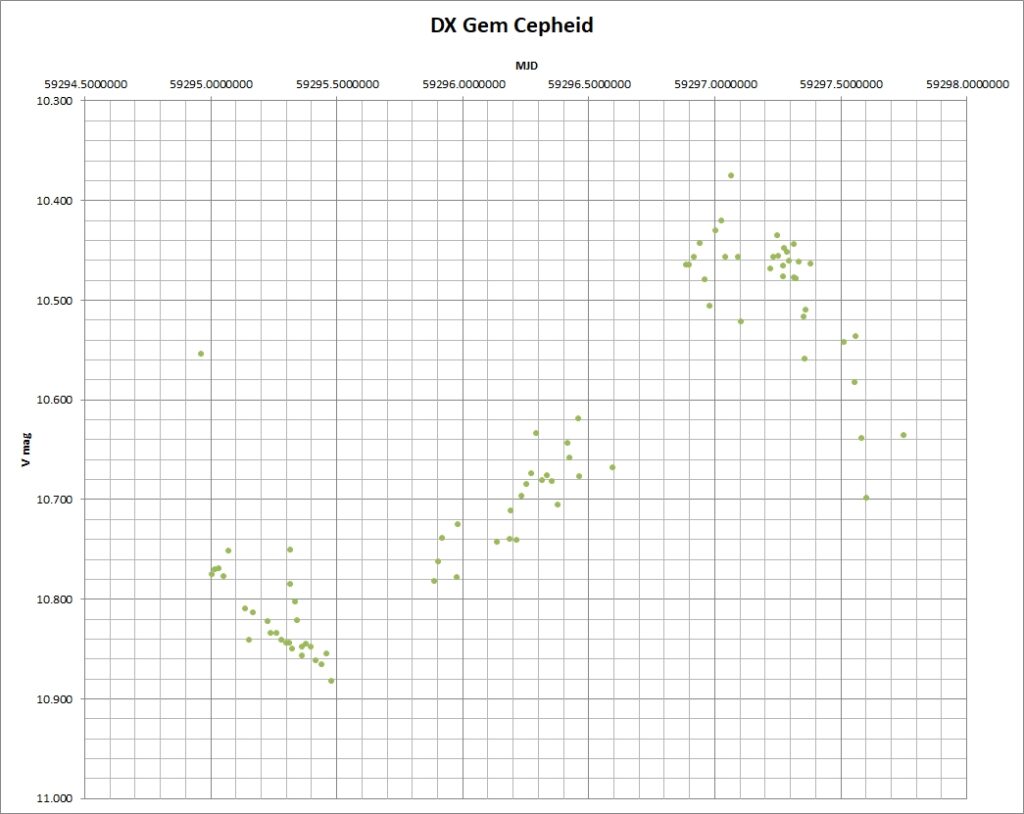
André Debackère suggested to observe the Cepheid named DX Gem. He realised that the 0.4m telescope field of view (19’ x 29’) would allow 3 other variables to be observed at the same time.

And so the “Four nations observing four variables” project had begun – and with France, Ireland, Norway and England working together, this could be a FINE collaboration 
The main target:
DX Gem
Cepheid, V range 10.53-10.92, Period = 3.1 d
The other variables are:
V0350 Gem
Long period Mira Ceti type, V range 11-14, Period ~444 d
BL Gem
Irregular variable, V~10.7, Period ~51.5 d
AZ Gem
Eclipsing binary in contact EB type (Beta Lyrae type), V range ~11.8-12.4, Period = 1.0 d
Our results:
Following a few successful observing runs for each partner during March, lightcurves were produced for all 4 variable stars. Data has been obtained in several filters (B,V and r’), so an investigation of colour changes can also be undertaken by students. The initial lightcurves below (V band data only) show clear evidence for variability in each target.
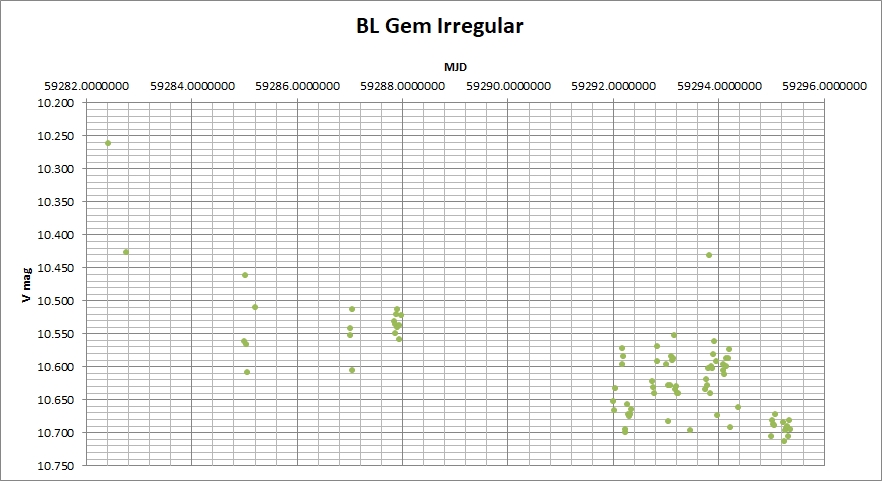
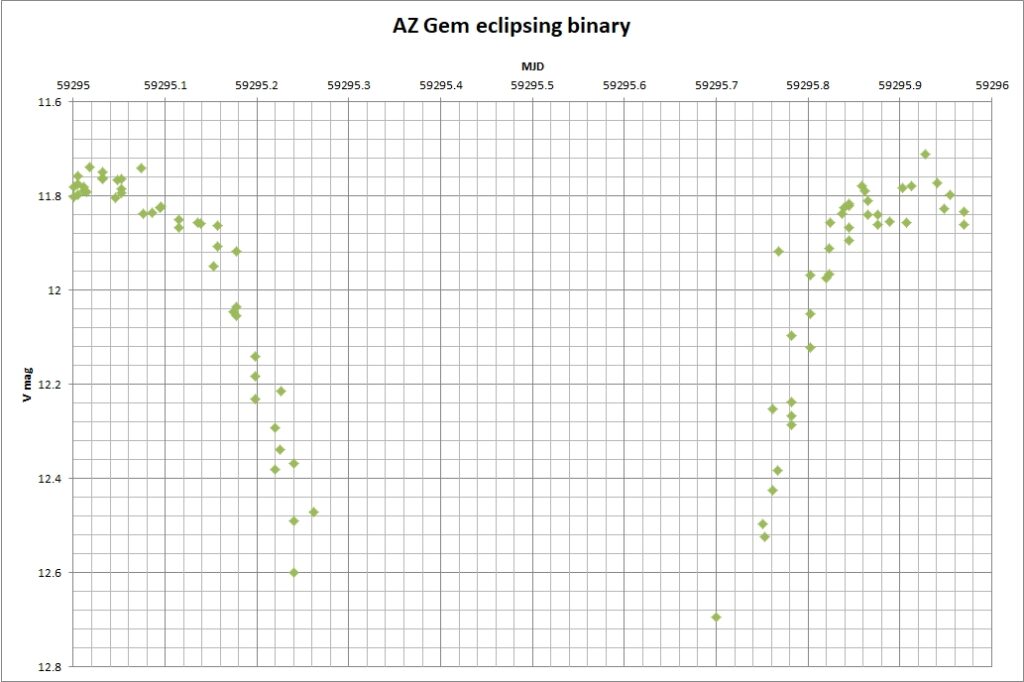
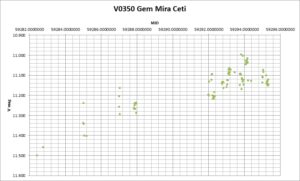
The team plan to continue monitoring this field, and will be updating their data archive over the next few months – so look out for new results! In particular, we will be looking not only at how the brightness of each star varies, but also how the colour changes with time, and finding out what that can tell us about the astrophysics going on in each case.
]]>
Ten students from five MINT-EC schools in Münster/Germany are happy about their participation in the discovery of four previously unknown “Near Earth Objects” (NEOs) after working with Paul Breitenstein (AiM project leader) and Dr. Tobias Jogler (astrophysicist and head of the Münster Planetarium). This work includes the discovery of an “Amor”-type asteroid 2020TX.
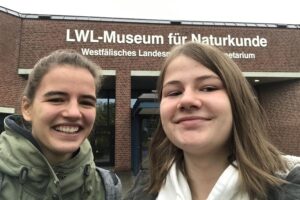
Hannah Spieker (grade 10) and Lucie Besmehn (grade 11) from the Nepomucenum high school in Coesfeld took part in the MINT-EC camp “Minor Planets”. MINT-EC is the national excellence network of schools with secondary level II and an excellent mathematical, scientific and technical school profile. Here is Hannah’s report:
From October 5th, 2020 to October 8th, 2020, Lucie from Q1 and I, Hannah from EF, were allowed to take part in the MINT-EC-Camp “Minor Planets” in the LWL Natural History Museum in Münster.
Right at the beginning of the workshop we got to know the large research telescopes in Siding Spring in Australia, which can also be remotely controlled by students via the Internet. With the one of the 0.4m reflectors we were able to take great pictures of various objects in our galaxy during the week. Lucie and I looked at the Eagle Nebula, a well-known example of an area where new stars are formed.
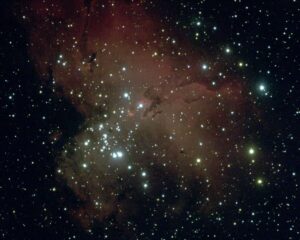
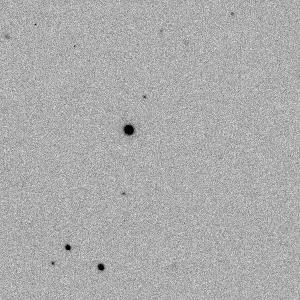
Image 1. RGB image of the Eagle Nebula (M16)
After that we went on an asteroid hunt! For this purpose, we assigned our own observation requests to the 2m Faulkes Telescope South in Siding Spring in order to take several images of possible asteroids. We then evaluated these images on our own laptops using the software “Astrometrica”. In fact, we were able to confirm the existence of three Near Earth Objects (NEOs for short) and to measure their orbital data.
Our measurement results can be viewed online in the publications of the Minor Planet Center, the official organization for the collection of data on minor planets: MPEC 2020-T40 (for the object 2020 TX), MPEC 2020-T45 (for 2020 TC1) and MPEC 2020-T87 (for 2020 TS2).
We were thus able to make a small contribution to current research. For example, NASA uses this data to track the trajectories of 2020 TX, 2020 TC1 and 2020 TS2.
Finally, a visit to the planetarium was on the program of the camp, during which it became clear to us once again what a tiny part we make up in the universe and how much is still to be discovered. In addition, Dr Jogler told us about his job as an astrophysicist and director of the planetarium in the natural history museum.
The camp was definitely a lot of fun, was very educational and a great opportunity to get an insight into research and scientific work.
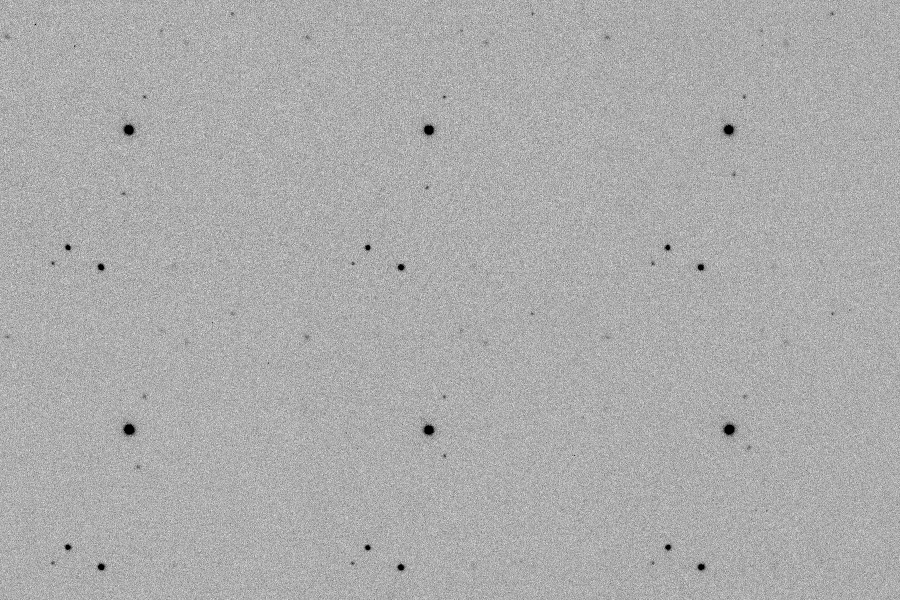
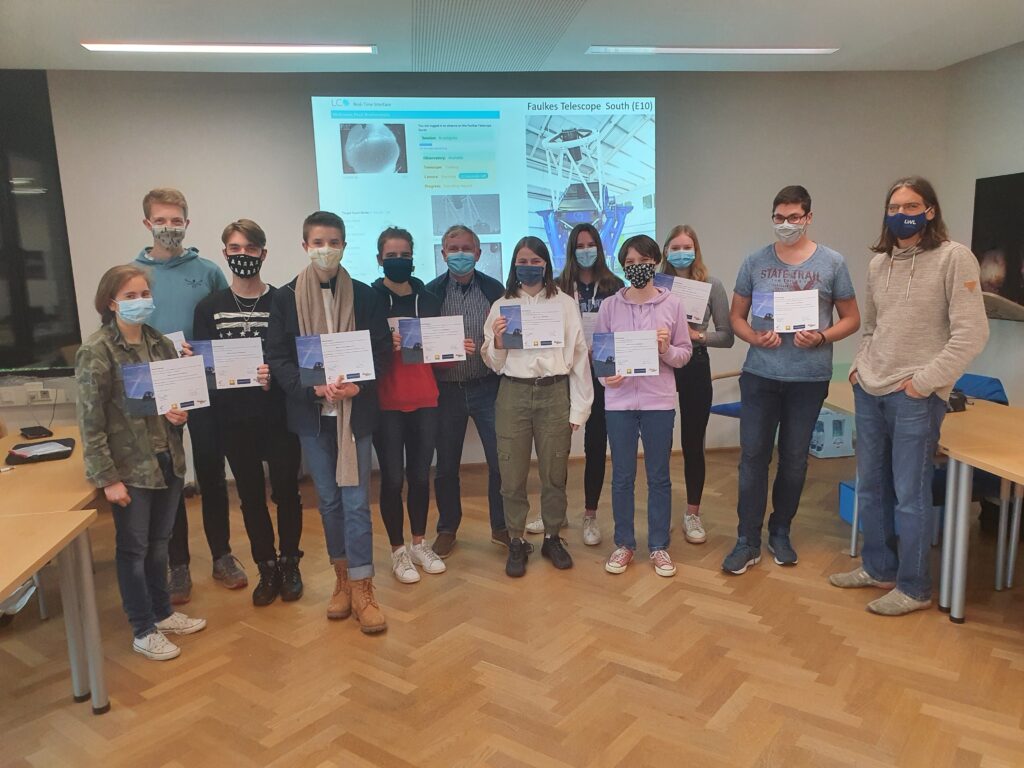
Image 3. Award of the certificates with P. Breitenstein (center) and Dr T. Jogler (right)
]]>The comet C / 2020 F3 (NEOWISE) was first reported on March 31, 2020 by the American Joseph R. Masiero to the Minor Planet Center (MPC). He had discovered the object on images taken on March 26 and 27, 2020 of the WISE satellite for the NEOWISE project.
Only a few hours later we were able to confirm this discovery with our pictures of the 2.0 meter Faulkes Telescope South in Siding Spring / Australia. These were the world’s first images of the newly discovered comet to be made from Earth!
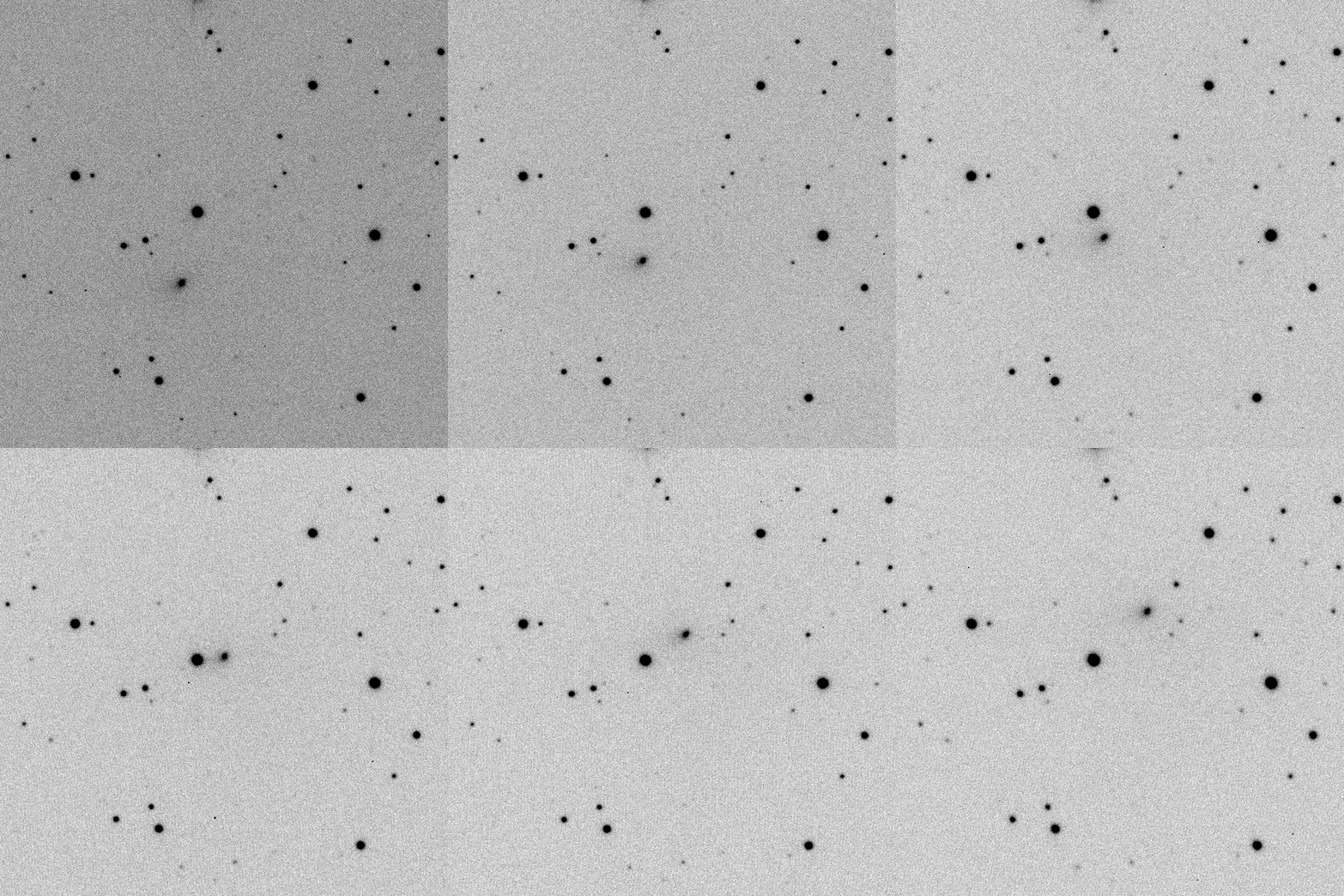
This has been confirmed by the Minor Planet Center (MPC) through the Minor Planet Electronic Circular MPEC 2020-G05.
C / 2020 F3 (NEOWISE) is a recurring comet with an almost parabolic orbit. The period is probably 6000 years or more.
Its brightness has increased so much in recent weeks that if we are lucky we can admire the comet in July 2020 with the naked eye in the northern sky. Unfortunately, comets are moody objects, such as comets C / 2019 Y4 (ATLAS) and C / 2020 F8 (SWAN) have proven.
The AiM Project Group can control 25 research telescopes from Münster via the Internet, including the 2m Faulkes Telescope in Siding Spring / Australia (FTS). AiM – Asteronomy and internet in Münsterhttp://aim-muenster.de/AiM-Project-Group/Some-Impressions/Comet-C/2020-F3-NEOWISE/