For this project we imaged various galaxies including interacting galaxies such as the Antennae and NGC2207, and other bright spirals such as M100 where we were just 4 days too early to catch a supernova!
Spurred on by our successful capture of these images we decided to focus on compact groups of galaxies and, by chance, selected a couple from the Hickson catalogue. This led to discussions with the Faulkes team at Cardiff on the possibility of joining a project to image in colour as many of the Hickson galaxies as possible.
Many of these groups are far more challenging than the initial galaxy project and tested to the limit our image processing skills. A complete list of the 100 or so Hickson groups was displayed on our notice board on club nights and members asked to ‘sponsor’ one or more groups. Each sponsor was asked to provide details of the group and the exposures and filters required to capture the image. Since most of the club members were unfamiliar with image processing software a couple of club nights were devoted to imaging tutorials.
All of our imaging using the Faulkes telescopes is done off-line, i.e. we submit request detailing the objects and the exposures required and we receive back raw Fits data for subsequent processing by club members
It was soon obvious that creating great images from the raw data was a
challenge that not everyone wanted to partake in, so a small and enthusiastic band of members formed an imaging sub group. This group does not confine itself to Faulkes images alone, but includes webcam, DSLR and CCD imaging. Software ranges from freeware such as Registax and Iris to professional packages such as Maxim DL and Photoshop. The aim of the group is to share imaging tips and skills in order to improve the overall imaging capabilities of the group.
Within this group we have now processed nearly two dozen sets of images from the Faulkes team to date, most of which have been Hickson groups. At one point we though we may have even discovered a new supernova in Hickson 51b (HCG51b), but alas it was later seen to be a star that was faint enough not to be on most star atlases, but happened to be in the line of
sight of the galaxy.
We were also very honoured to have some of our processed Hickson images published in a paper entitled “Faulkes Telescope North Observations of Hickson Groups of Interacting Galaxies”
(F.Lewis, P.Roche, S. Roberts, N.Szymanek, Bristol Astronomical Society) as part of the goal to produce multi-colour online version of the Hickson atlas.
The society has put on display many of the images during outreach events
such as the annual Bristol Festival of Nature events, bringing astronomy
and the beauty of these elusive objects to the public eye. Many of these images can also be found on the Bristol Astrosoc website http://www.bristolastrosoc.org.uk/wb/index.php.
We are indebted to the Faulkes team for their support and the opportunity and impetus it has given to our members to participate in such a challenging and exciting aspect of our hobby.
]]>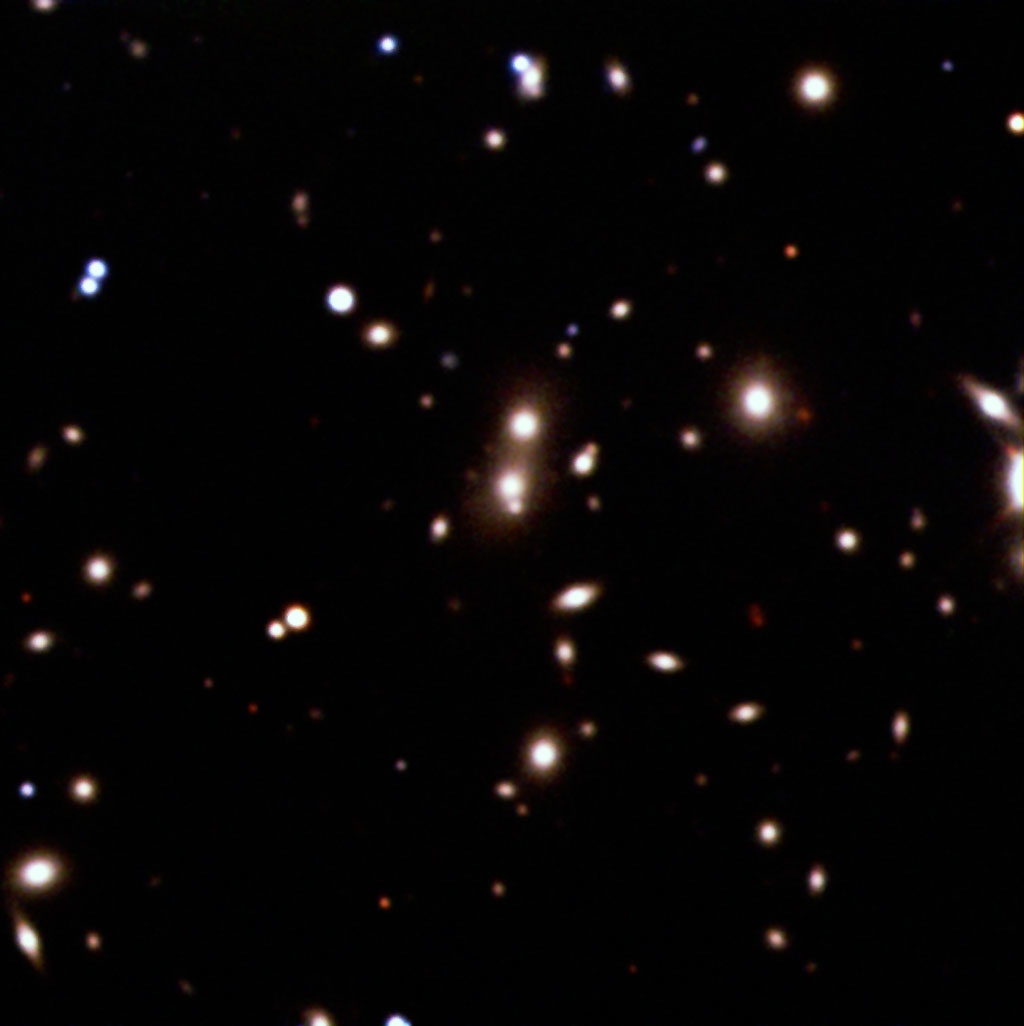
Oliver Tunnah, a regular user of the FTs took this great image of the distant galaxy cluster Abell 2065 during one session on FTS. Here is his account of how he imaged this cluster nearly 940 million light years away.
“Before hand I didn’t have any of the galaxy numbers. (This object is faint and is very challenging visually. There isn’t that much about it on the internet compared to other galaxy clusters.) I used Google Sky to get the co-ordinates. I framed it so that the bright star is out of view. (If you’re wondering, 4.6 arc mins roughly equates to a 4′ 15” FOV in Google sky.) This also allowed me to get the central part of the cluster nicely.
Because it was quite faint I decided to take three 120 second exposures. But faint compact targets are what the FT’s excel at, see my IC 466 as proof. Three exposures equate to 360 mins in each filter. Taking three allows me to get a longer exposure and reduce noise (which seems to be creeping back in with the scopes, FTS in particular.) I added three red images together and did the same for Green and Blue before combining them to make the RGB image.
I was drawn to this cluster by an article in Astronomy Magazine (I subscribe to this one and not Astronomy now) about galaxy clusters. Me, liking multiple galaxies in an image, especially if they are crashing, couldn’t resist.
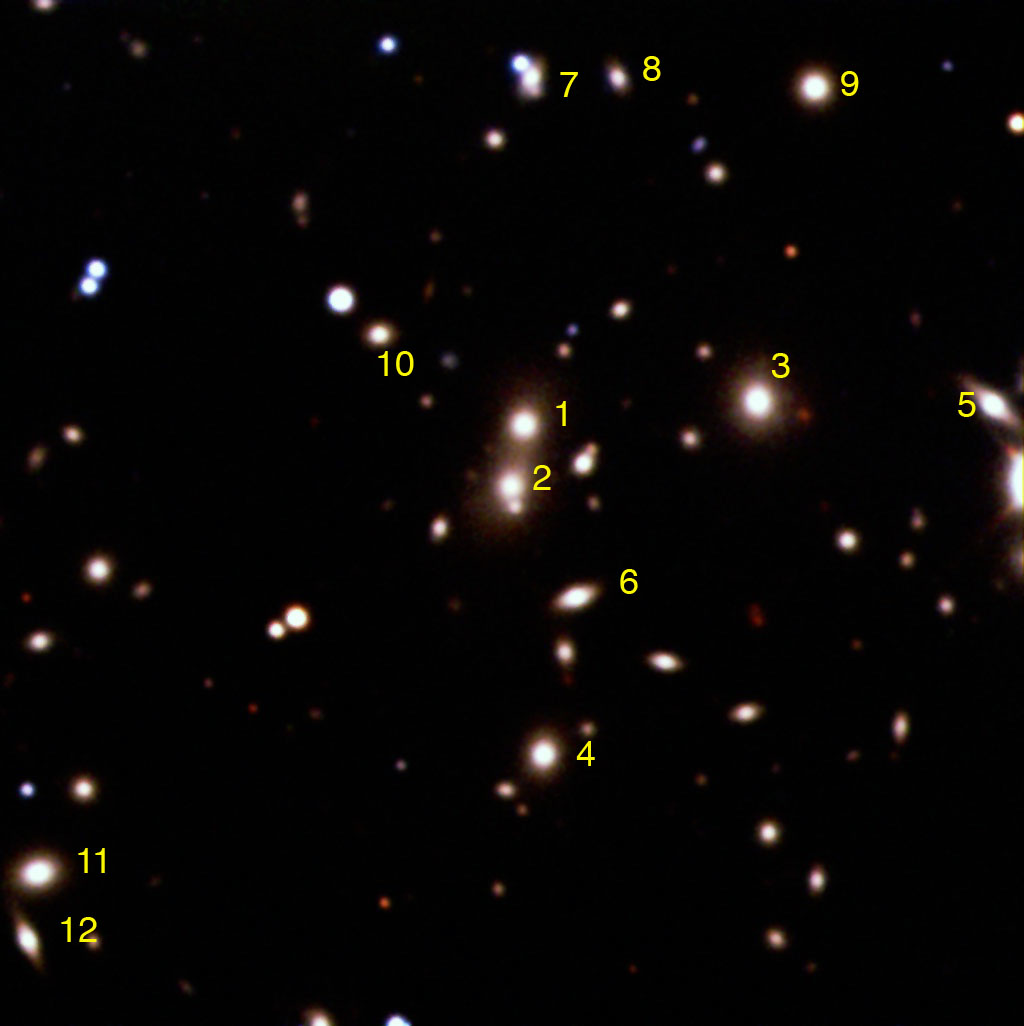 Many clusters are quite spread out and require mosaics to get even a few members. But Abell 2065 stood out. It does stretch a mighty 40′ north to south and 30′ East to West but most of the galaxies occupy a central 15′ (or one full Moon width.) However I got more than 50 galaxies in just one image. A number of these are listed below and labelled in the image. ”
1:PGC 54888
2:PGC 54883
3:PGC 84576
4:PGC 54884
5:PGC 54869
6:PGC 54881
7:PGC 1816776
8:MAPS-NGP 0-328-0332012
9:PGC 84875
10:PGC 1816164
11:PGC 54891
12:PGC 54890
For more images of the Abell 2065 cluster, click here to go to the SDSS Navigate tool. From this you can click on any of the Abell cluster objects in the field and obtain more information about them and better resolution images.
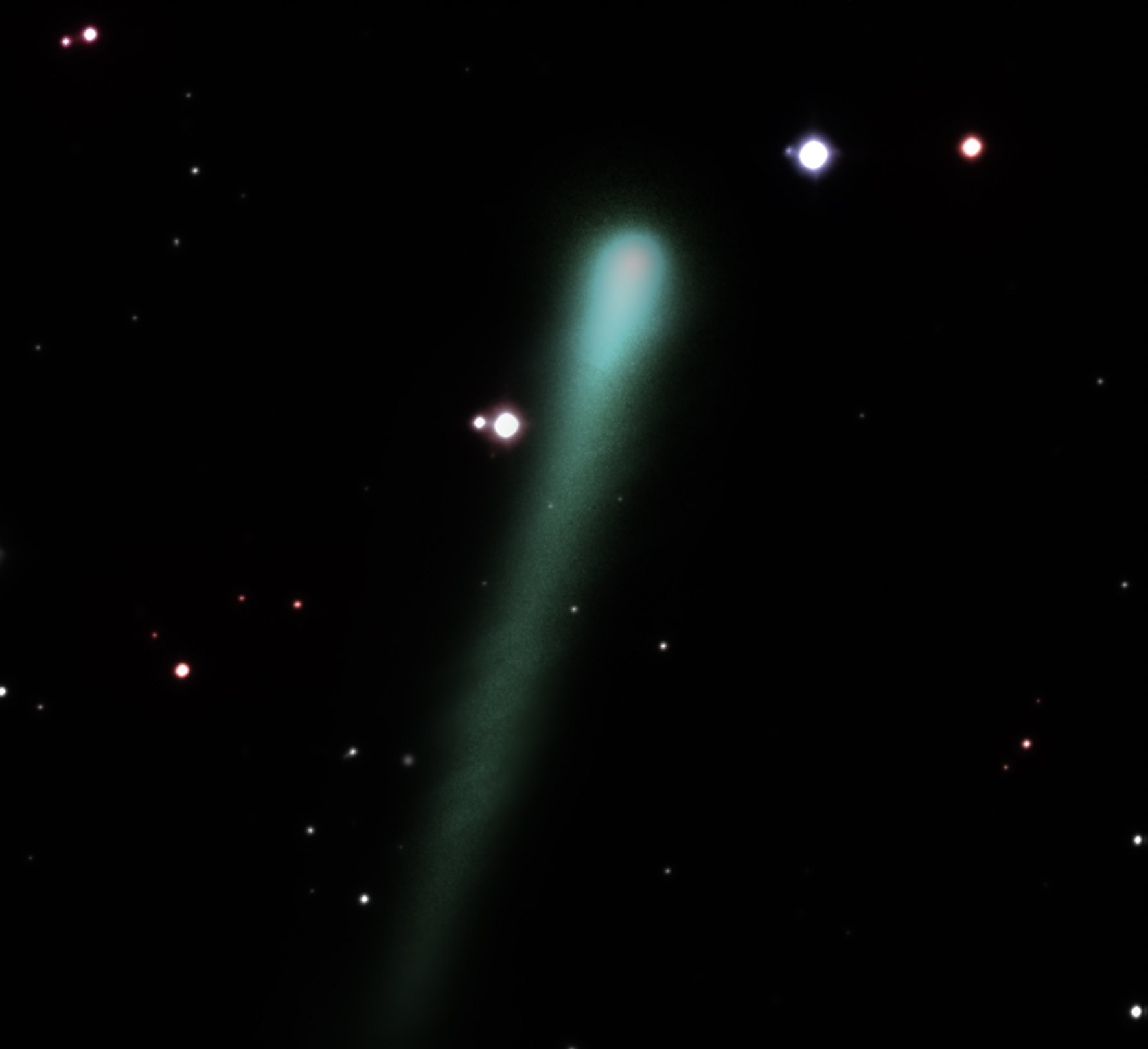
As part of the BBC’s Stargazing Live event, users of the FTs have been asked to image interesting objects. This lovely image of Comet Cardinal was taken by amateur astronomer Nick Howes, using FTN.