Background
The European Space Agency’s Rosetta mission made Comet 67P/Churyumov-Gerisamenko one of the most famous comets. The mission orbited the comet for over 2 years with the Philae lander the first spacecraft to land on a comet. The mission finished data collection on 30 September 2016, but the analysis of that data continues. Even though we have already learnt a lot about the comet from close-up study, comets are dynamic bodies and so continued monitoring from Earth is still important to see the comet’s evolution.
The comet takes just under 6.5 years to make a full orbit of the Sun. It is most active and brightest when it is closest to the sun (called perihelion). The comet is currently travelling towards the Sun, and the Earth, and will reach perihelion at the start of November 2021. Professional and amateur astronomers across the world are eagerly waiting to observe the comet again.
Comet Chasers
The Faulkes Telescope Project is also planning to engage schools in making observations and analysing data to monitor changes in the comet’s position, brightness, size and shape. This will help professional and amateur researchers. In preparation we are working with comet researchers (including Helen Usher, who is studying 67P as part of her PhD) and experienced observers, including Tony Angel and Richard Miles (British Astronomical Association) who were part of the ground-based campaign set up in support of the Rosetta mission in 2015-2016.
Here Tony tells us more about the observations he has recently made, and how he has analysed and presented them. Tony will be available to help schools take their own images and do similar analysis. We hope that as the comet gets closer this will be easier, and we hope the comet will show more detail!
Tony’s Tale
After hearing that 67P had been recovered I made a request for an observation. To me, it is like an old friend returning as I had taken quite a few images of it when it visited us last time.
I thought that I would have a better chance of an observation if I went for one of the smaller telescopes – a 0.4 metre one. The request for 8 x 3-minute observations locked on the comet, using a clear filter.
Why such long exposures? The comet is still very faint and so lots of light needed to be collected.
Why not just one image of 24 minutes? Three reasons…
- If the comet passed too close to a background or foreground star, the overflowing photons (light) from the star might hide the comet
- Sometimes with automatic observing, the first image may start before the telescope has finished aligning (this happened in this case and only 7 images were usable)
- It might have been possible to make a short animation of the comet (in this case it was not possible as the comet was too faint and only really visible when the images were stacked on top of each other using Astrometrica)
Why use a clear filter?
When I first image an object I tend to use a clear filter, especially if the object is very dim. I want to collect as much light as possible and see how it comes out with the selected settings, and the clear filter lets the most light through. I can then select an appropriate (narrower) filter and modify, if necessary, the other settings. In this case, if I had used say an r (red) filter, I believe that with the settings I used, I would not have captured the comet.
The Images
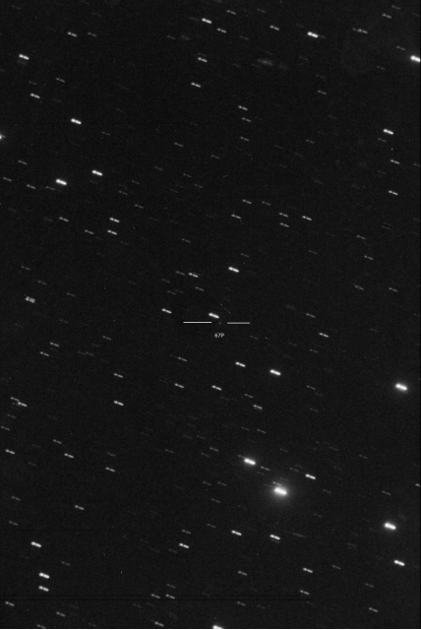
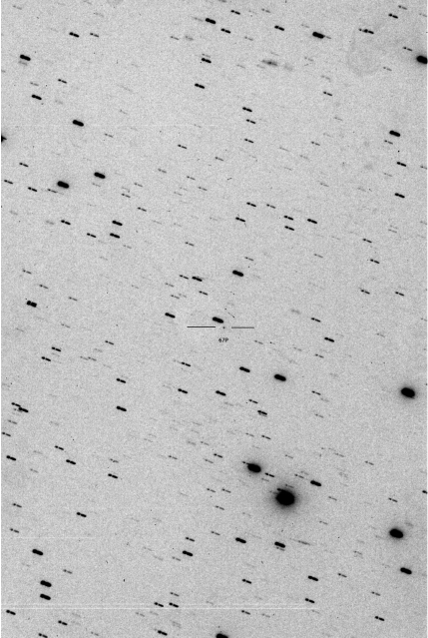
The image on the left is a positive image. I have rotated the image so that North is at the top. The comet is quite difficult to make out, so I have highlighted it with two lines on either side of it. The image on the right is a negative image. Here, the comet is more obvious and illustrates why most astronomers prefer to work with Negatives rather than Positives. You can see how the comet is seen as a dot, while the stars are lines. This is because I set the telescope to follow the comet and it moves at a different speed to how the stars move across the sky (due to Earth’s rotation).
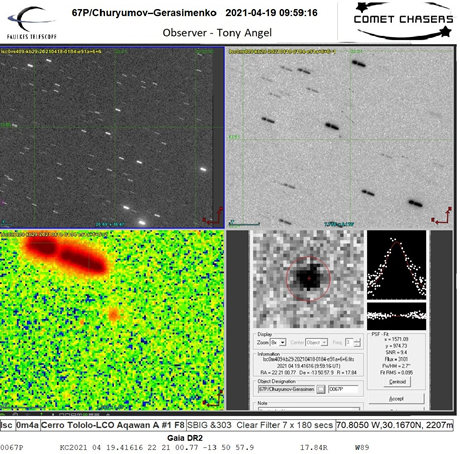
Composite using Aladin
Aladin is one of a number of professional tools that are freely available to both professionals and amateurs. It quite a few nice features including displaying the scale of the image, RA & Dec lines and North indicators. If the comet had a tail or a decent sized coma, I could have used tools to measure them.
The first box shows a slightly zoomed in Positive image. The second shows a more zoomed in Negative image. The third box shows a false colour image, which often reveals more detail.
The fourth box shows the information box produced by Astrometric, showing the date and time of the observation, the RA and Dec (position) of the comet and its magnitude.
Aladin has options for the user to choose how to display data.
I use Windows Paint to add a Header and Footer. The Footer contains other information not included in the image, such as the Name of the Observatory, the Telescope, CCD and filters used. The Latitude and Longitude of the Observatory, in this case – The lsc, 0m4a telescope at Cerro Tololo-LCO.
Finally, a text line generated by Astrometrica contains all the information required that can be sent to the MPC (Minor Planet Center), which includes the comet’s position and its measured brightness. This information is used to help determine the comet’s orbit and activity.
]]>The comet C / 2020 F3 (NEOWISE) was first reported on March 31, 2020 by the American Joseph R. Masiero to the Minor Planet Center (MPC). He had discovered the object on images taken on March 26 and 27, 2020 of the WISE satellite for the NEOWISE project.
Only a few hours later we were able to confirm this discovery with our pictures of the 2.0 meter Faulkes Telescope South in Siding Spring / Australia. These were the world’s first images of the newly discovered comet to be made from Earth!
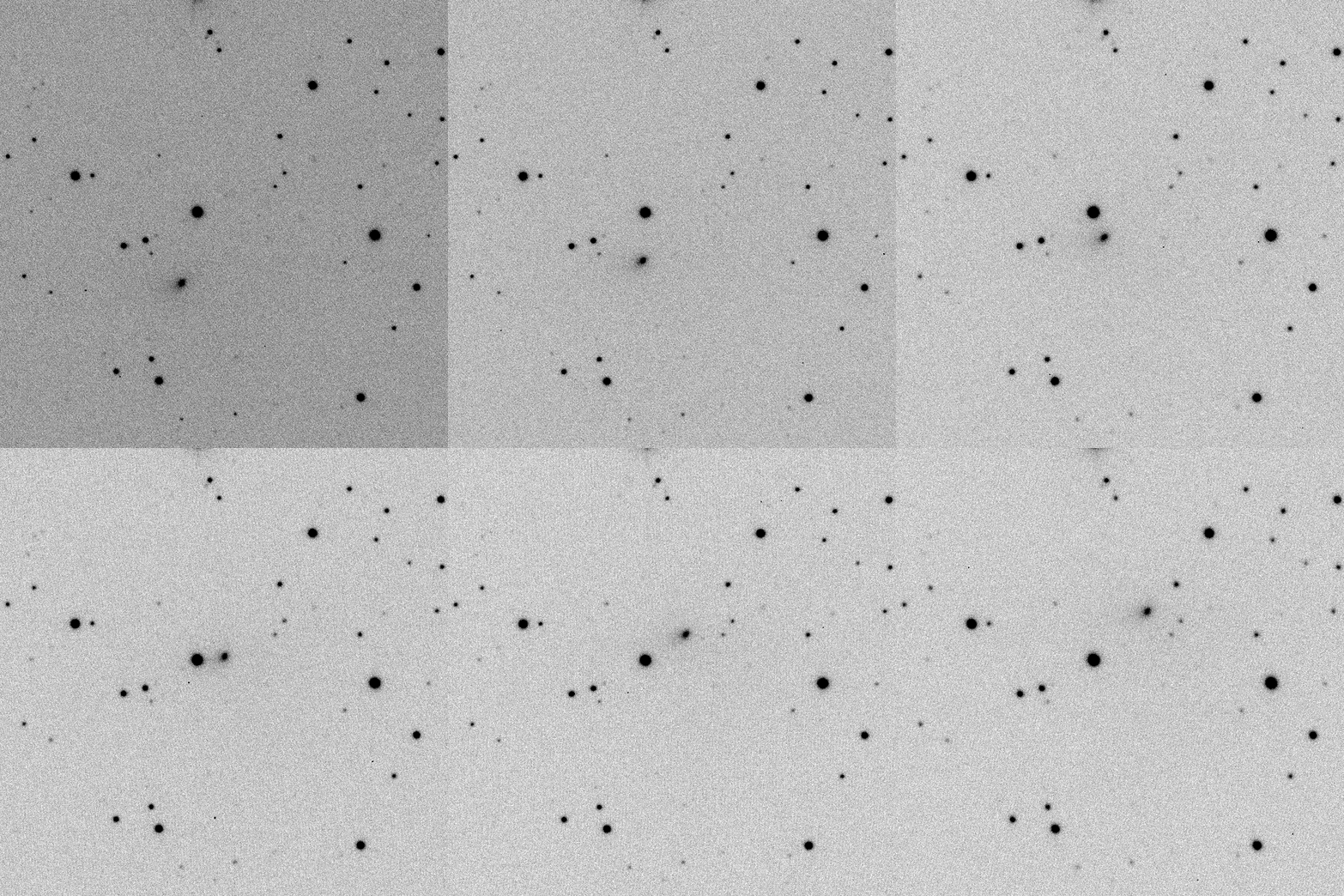
This has been confirmed by the Minor Planet Center (MPC) through the Minor Planet Electronic Circular MPEC 2020-G05.
C / 2020 F3 (NEOWISE) is a recurring comet with an almost parabolic orbit. The period is probably 6000 years or more.
Its brightness has increased so much in recent weeks that if we are lucky we can admire the comet in July 2020 with the naked eye in the northern sky. Unfortunately, comets are moody objects, such as comets C / 2019 Y4 (ATLAS) and C / 2020 F8 (SWAN) have proven.
The AiM Project Group can control 25 research telescopes from Münster via the Internet, including the 2m Faulkes Telescope in Siding Spring / Australia (FTS). AiM – Asteronomy and internet in Münsterhttp://aim-muenster.de/AiM-Project-Group/Some-Impressions/Comet-C/2020-F3-NEOWISE/
First earth-based images:
2m Faulkes Telescope South (E10)
Siding Spring/Australia
22 x 40s
Filter R
March 31, 2020
09:03:48 – 09:30:20 UT
]]>Our publications are
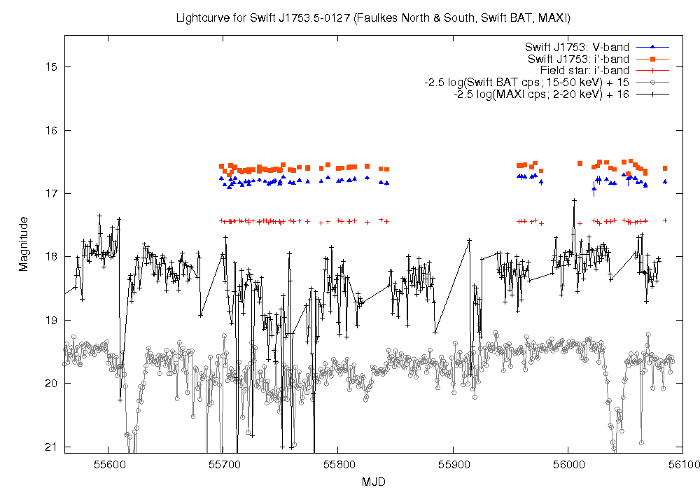
“A 420-day X-ray/optical modulation and extended X-ray dips in the short-period transient Swift J1753.5-0127” (Charles et al., MNRAS)
“Up and Down the Black Hole Radio/X-Ray Correlation: The 2017 Mini-outbursts from Swift J1753.5-0127” (Plotkin et al., ApJ)
“Bright Mini-outburst Ends the 12 yr Long Activity of the Black Hole Candidate Swift J1753.5─0127” (Zhang et al., ApJ)
Long-term light curve for the XRB, Swift J1753.5-0127 (2011 – 2012)
Click here to return to the main XRB page
]]>As part of a wider investigation of evolved massive stars in Galactic open clusters, we have spectroscopically identified three candidate classical Cepheids in the little-studied clusters Berkeley 51, Berkeley 55 and NGC 6603.
Using new multi-epoch photometry, we confirm that Be 51 #162 and Be 55 #107 are bona fide Cepheids, with pulsation periods of 9.83+/-0.01 d and 5.850+/-0.005 d respectively, while NGC 6603 star W2249 does not show significant photometric variability. Using the period-luminosity relationship for Cepheid variables, we determine a distance to Be 51 of 5.3(+1.0,-0.8) kpc and an age of 44(+9,-8) Myr, placing it in a sparsely-attested region of the Perseus arm. For Be 55, we find a distance of 2.2+/-0.3 kpc and age of 63(+12,-11) Myr, locating the cluster in the Local arm. Taken together with our recent discovery of a long-period Cepheid in the starburst cluster VdBH222, these represent an important increase in the number of young, massive Cepheids known in Galactic open clusters.
We also consider new Gaia (data release 2) parallaxes and proper motions for members of Be 51 and Be 55; the uncertainties on the parallaxes do not allow us to refine our distance estimates to these clusters, but the well-constrained proper motion measurements furnish further confirmation of cluster membership. However, future final Gaia parallaxes for such objects should provide valuable independent distance measurements, improving the calibration of the period-luminosity relationship, with implications for the distance ladder out to cosmological scales.
Read the preprint here
]]>We characterized the broad-band X-ray spectra of Swift J1745-26 during the decay of the 2013 outburst using INTEGRAL ISGRI, JEM-X and Swift XRT. The X-ray evolution is compared to the evolution in optical and radio. We fit the X- ray spectra with phenomenological and Comptonization models. We discuss possible scenarios for the physical origin of a ~50 day flare observed both in optical and X- rays ~170 days after the peak of the outburst. We conclude that it is a result of enhanced mass accretion in response to an earlier heating event. We characterized the evolution in the hard X-ray band and showed that for the joint ISGRI-XRT fits, the e-folding energy decreased from 350 keV to 130 keV, while the energy where the exponential cut-off starts increased from 75 keV to 112 keV as the decay progressed.We investigated the claim that high energy cut-offs disappear with the compact jet turning on during outburst decays, and showed that spectra taken with HEXTE on RXTE provide insufficient quality to characterize cut-offs during the decay for typical hard X-ray fluxes. Long INTEGRAL monitoring observations are required to understand the relation between the compact jet formation and hard X-ray behavior. We found that for the entire decay (including the flare), the X-ray spectra are consistent with thermal Comptonization, but a jet synchrotron origin cannot be ruled out.
Paper here
]]>Context. Edge-on galaxies can offer important insights in galaxy evolution as they are the only systems where the distribution of the different components can be studied both radially and vertically. The HEROES project was designed to investigate the interplay between the gas, dust, stars and dark matter (DM) in a sample of 7 massive edge-on spiral galaxies.
Aims. In this second HEROES paper we present an analysis of the atomic gas content of 6 out of 7 galaxies in our sample. The remaining galaxy was recently analysed according to the same strategy. The primary aim of this work is to constrain the surface density distribution, the rotation curve and the geometry of the gas disks in a homogeneous way. In addition we identify peculiar features and signs of recent interactions.
Methods. We construct detailed tilted-ring models of the atomic gas disks based on new GMRT 21-cm observations of NGC 973 and UGC 4277 and re-reduced archival HI data of NGC 5907, NGC 5529, IC 2531 and NGC 4217. Potential degeneracies between different models are resolved by requiring a good agreement with the data in various representations of the data cubes.
Results. From our modelling we find that all but one galaxy are warped along the major axis. In addition, we identify warps along the line of sight in three galaxies. A flaring gas layer is required to reproduce the data only for one galaxy, but (moderate) flares cannot be ruled for the other galaxies either. A coplanar ring-like structure is detected outside the main disk of NGC 4217, which we suggest could be the remnant of a recent minor merger event. We also find evidence for a radial inflow of 15 +- 5 km/s in the disk of NGC 5529, which might be related to the ongoing interaction with two nearby companions.
Read the paper here
]]>Context Galactic starburst clusters play a twin role in astrophysics, serving as laboratories for the study of stellar physics and also delineating the structure and recent star formation history of the Milky Way.
Aims In order to exploit these opportunities we have undertaken a spectroscopic survey of the red supergiant dominated young massive clusters thought to be present at both near and far ends of the Galactic Bar.
Methods Specifically, multi-epoch observations were employed to identify and investigate stellar variability and its potential role in initiating mass loss amongst the cool super-/hypergiant populations of these aggregates.
Results Significant spectroscopic variability suggestive of radial pulsations was found for the yellow supergiant VdBH222 #505. Follow-up photometric investigations revealed modulation with a period of ~ 23.325 d; both timescale and pulsational profile are consistent with a Cepheid classification.
Conclusions #505 is one of the longest period Galactic cluster Cepheids identified to date and hence of considerable use in constraining the bright end of the period/luminosity relation at solar metallicities. In conjunction with extant photometry we infer a distance of ~ 6kpc for VdBH222 and an age of ~ 20Myr. This results in a moderate reduction in both the integrated cluster mass (2 × 10^4 solar masses) and the initial masses of the evolved cluster members (~ 10 solar masses). As such VdBH222 becomes an excellent test-bed for studying the properties of some of the lowest mass stars observed to undergo type-II supernovae. Moreover, the distance is in tension with a location of VdBH222 at the far end of the Galactic Bar. Instead a birthsite in the near 3kpc arm is suggested; providing compelling evidence of extensive recent star formation in a region of the inner Milky Way which has hitherto been thought to be devoid of such activity.
Read the pre-print here
]]>Levitan (Caltech), Fraser Lewis (FT, LJMU), Ashish A. Mahabal (Caltech), Eran O. Ofek (Weizmann Institute of Science, Israel), Thomas A. Prince (Caltech), Scott M. Ransom (NRAO, Virginia), Mallory S. E. Roberts, David M. Russell (New York University Abu Dhabi), Branimir Sesar (MPIA, Germany), Jason A. Surace (IPAC, Caltech), Sumin Tang (Caltech)
PSR J2129−0429 is a “redback” eclipsing millisecond pulsar binary with an unusually long 15.2 hour orbit. It was discovered by the Green Bank Telescope in a targeted search of unidentified Fermi gamma-ray sources. The pulsar companion is optically bright (mean mR = 16.6 mag), allowing us to construct the longest baseline photometric dataset available for such a system. We present ten years of archival and new photometry of the companion from LINEAR, CRTS, PTF, the Palomar 60-inch, and LCOGT. Radial velocity spectroscopy using the Double-Beam Spectrograph on the Palomar 200- inch indicates that the pulsar is massive: 1.74 ± 0.18 solar masses. The G-type pulsar companion has mass 0.44 ± 0.04 solar masses , one of the heaviest known redback companions. It is currently 95±1% Roche-lobe filling and only mildly irradiated by the pulsar. We identify a clear 13.1 mmag yr−1 secular decline in the mean magnitude of the companion as well as smaller-scale variations in the optical lightcurve shape. This behavior may indicate that the companion is cooling. Binary evolution calculations indicate that PSR J2129−0429 has an orbital period almost exactly at the bifurcation period between systems that converge into tighter orbits as black widows and redbacks and those that diverge into wider pulsar–white dwarf binaries. Its eventual fate may depend on whether it undergoes future episodes of mass transfer and increased irradiation.
Read the preprint here
]]>On 2015 June 15 the burst alert telescope (BAT) on board Swift detected an X-ray outburst from the black hole transient V404 Cyg. We monitored V404 Cyg for the last 10 years with the 2-m Faulkes Telescope North in three optical bands (V, R, and i′). We found that, one week prior to this outburst, the optical flux was 0.1–0.3 mag brighter than the quiescent orbital modulation, implying an optical precursor to the X-ray outburst. There is also a hint of a gradual optical decay (years) followed by a rise lasting two months prior to the outburst. We fortuitously obtained an optical spectrum of V404 Cyg 13 hours before the BAT trigger. This too was brighter (~ 1 mag) than quiescence, and showed spectral lines typical of an accretion disk, with characteristic absorption features of the donor being much weaker. No He II emission was detected, which would have been expected had the X-ray flux been substantially brightening. This, combined with the presence of intense Hα emission, about 7 times the quiescent level, suggests that the disk entered the hot, outburst state before the X-ray outburst began. We propose that the outburst is produced by a viscous-thermal instability triggered close to the inner edge of a truncated disk. An X-ray delay of a week is consistent with the time needed to refill the inner region and hence move the inner edge of the disk inwards, allowing matter to reach the central BH, finally turning on the X-ray emission.
Read the preprint here
]]>We study in detail the evolution of the 2015 outburst of GS 1354-64 (BW Cir) at optical, UV and X-ray wavelengths using Faulkes Telescope South, SMARTS and Swift. The outburst was found to stay in the hard X-ray state, albeit being anomalously luminous with a peak luminosity of LX> 0.15 LEdd, which could be the most luminous hard state observed in a black hole X-ray binary. We found that the optical/UV emission is tightly correlated with the X-ray emission, consistent with accretion disc irradiation and/or a jet producing the optical emission. The X-ray spectra can be fitted well with a Comptonisation model, and show softening towards the end of the outburst. In addition, we detect a QPO in the X-ray lightcurves with increasing centroid frequency during the peak and decay periods of the outburst. The long-term optical lightcurves during quiescence show a statistically significant, slow rise of the source brightness over the 7 years prior to the 2015 outburst. This behaviour as well as the outburst evolution at all wavelengths studied can be explained by the disc instability model with irradiation and disc evaporation/condensation.
Read the preprint here
]]>