FT North has run for a few years with MuSCAT3 (Multicolor Simultaneous Camera for studying Atmospheres of Transiting exoplanets) and now MuSCAT4 has replaced the Spectral camera on FT South.
These cameras are identical and both provide the opportunity to collect data simultaneously in 4 filters. These filters are the Sloan/SDSS g’ r’ i’ filters and zs filter. The g’ and r’ filters can be thought of as green (or maybe blue/green) and red with the i’ and zs moving us toward the near-infrared part of the electromagnetic spectrum.
The default mode in queue-scheduled observations will allow our users to select a single exposure time where the camera will observe in each filter at the same time, making it much more efficient. More advanced users can select exposure times for the filters independently should they wish.
In real-time mode, only g’ r’ i’ are available as has been the case on FT North for a while now.
]]>Known for its explosive personality, comet 29P/Schwassmann–Wachmann is causing quite a stir. A few weaker outbursts have been detected over the past few days as seen in the latest lightcurve (Figure 1).
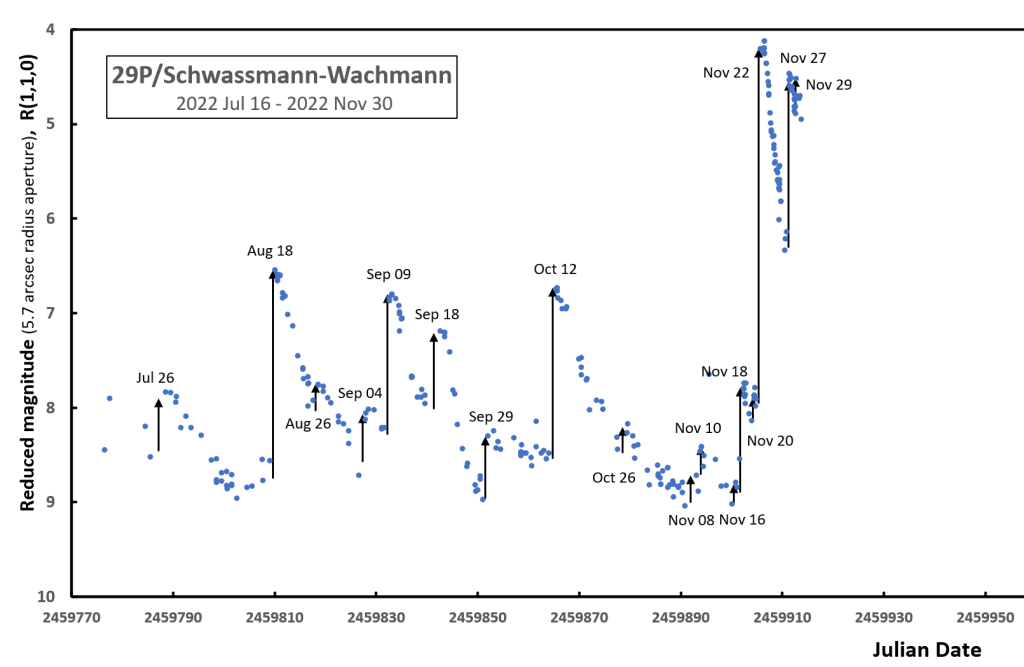
Figure 1. 29P/Schwassmann-Wachmann comet lightcurve
The outburst of the 29th of November was detected thanks to imaging by Ben Wooding at St Mary’s School in Bridgend, Wales. Image processing of the latest 1.0-m exposures from Las Cumbres Observatory, Chile, confirmed this new strong outburst. In other words, a further cryo-eruption was triggered.
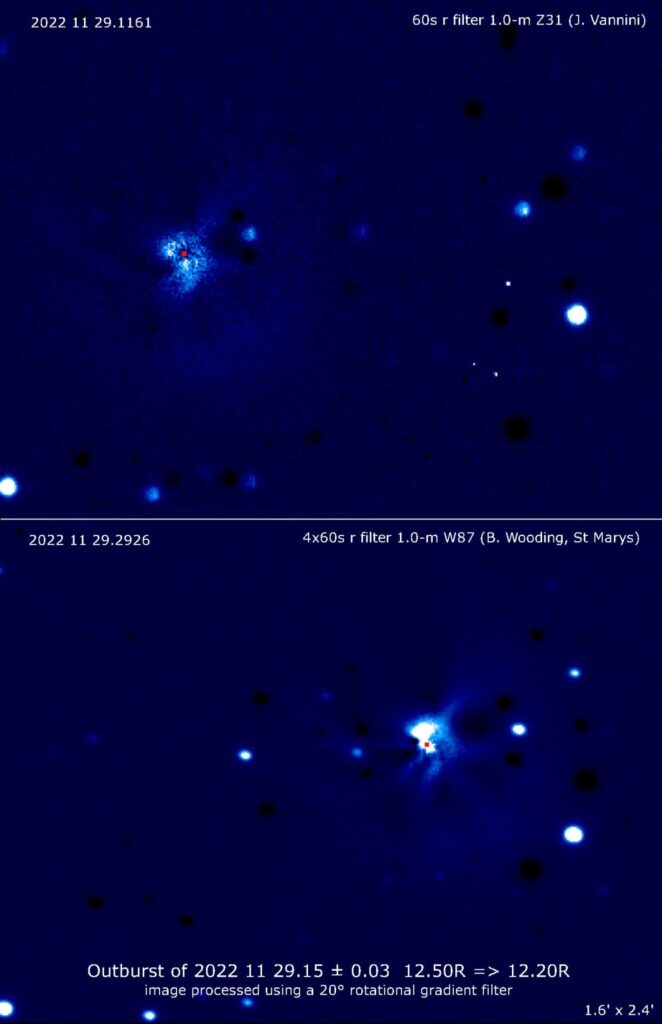
Figure 2. Top image by Julio Vannini, bottom image by Ben Wooding
What is remarkable is that the lower image in Figure 2 shows a new fan-shaped feature extending to about 3 arcsec from the nucleus, yet this appeared only 2-3 hours after this eruption began. To do this, the leading edge must have travelled at speeds up to about 1.0 km/s projected on the sky. This makes this latest event unusual and suggests that it is gas-driven from a relatively warm source at around 70-90 K.
Moreover, is that the brightening of November 29 was rather short-lived. This is something that might have been missed in the past.
We need URGENT help with observations. While the 2.0-m Faulkes Telescope North is affected by bad weather and nearby volcanic activity, do continue to use the 1.0-m telescopes and the 2.0-m telescope from Faulkes Telescope South. An exposure of 60s will work well.
If any help is needed setting this up, please contact one of the people below:
Helen Usher – helen.usher@open.ac.uk
Cai Stoddard-Jones – Stoddard-JonesIC@cardiff.ac.uk
Richard Miles – rmiles.btee@btinternet.com
all of whom will happily assist!
More information can be found by following this link:
]]>Comet 29P is causing some excitment again! This time with an outburst taking its R magnitude from 15.7 to 11.95. (This is the second biggest outburst in the last 12 years – see web link below).
You can help monitor how it develops by making observations for Richard Miles as part of the BAA Mission 29P campaign. The best observations will be 60s with the 2m Muscat Faulkes North telescope. This would be a great target if you have an RTI slot. You can also schedule with the 1m telecopes – the SDSS rp filter is best. Again an exposure of 60s will work well.
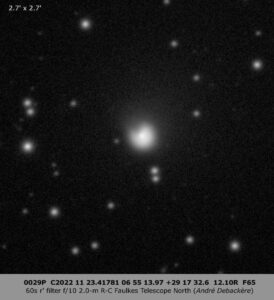
Your data will then be added to the BAA website – the picture below is from an FT user. MISSION 29P – Centaur comet observing campaign
If you would like help to set this up then just contact:
Helen Usher – helen.usher@open.ac.uk
Cai Stoddard-Jones – Stoddard-JonesIC@cardiff.ac.uk
or Richard Miles – rmiles.btee@btinternet.com
who will happily assist!
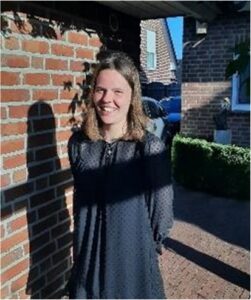
Anna Köster, 17
Anna Köster, a 17 years old student from Germany has found proof of systematic variation in the eclipse times of the binary star system CSS080502. A potential reason for this variation could be the presence of one or more exoplanets. While Anna has not been able to confirm the existence of an exoplanet around CSS080502, she will continue to make observations using the Faulkes Telescopes to gather further evidence.
The 17 years old had her proper introduction to Astronomy in the autumn of 2020 when she took part in the “Astronomy 2.0” camp. Under the supervision of Paul Breitenstein, Anna and other students used the Faulkes Telescope in Siding Spring, Australia to confirm “Near-Earth-Objects”. Inspired by her unique experience, she decided to write for school her term paper entitled “Methods of Detection of Exoplanets Using the Example of the Binary Star System CSS080502”.
In her term paper, she explores the theoretical basis of various methods used by professional astrophysicists to detect exoplanets. However, for the practical part of her term paper, Anna analysed the time of the eclipses of the binary star system and plotted the following observed-minus-calculated (O-C) diagram. The diagram highlights the systematic variation that was found. By looking at the diagram, Anna formulated the hypothesis that an exoplanet on a circular orbit might be present around the system. To confirm this presumption, she observed the eclipse using the 1.0m telescopes provided by FTP.
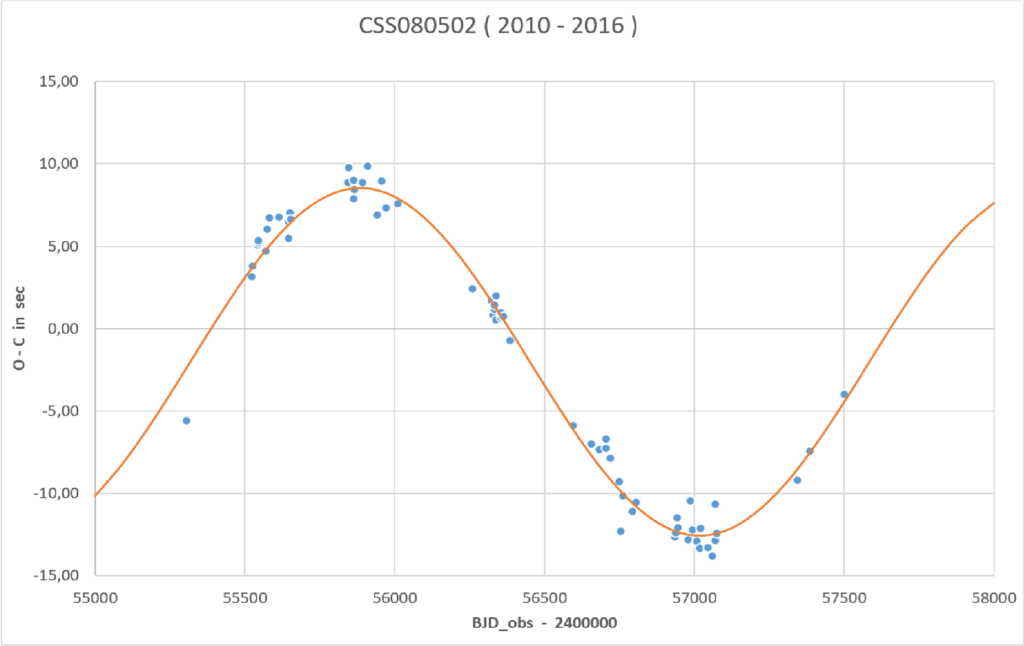
O-C diagrams are powerful tools that allow us to notice subtle changes in periodic astrophysical events
After further calculations, she rejected the possibility of an exoplanet on a circular orbit. Nonetheless, the variation might still be explained by an exoplanet on a highly elliptical orbit.
Despite not being able to identify an exoplanet orbiting the binary star system CSS080502, Anna said that she enjoyed the opportunity to fulfil her wish of carrying out actual scientific research using professional tools. Hopefully, she will be even more successful with her future observations.
More details about Anna’s work and experience with can be found here.
]]>Interacting Galaxies
During the first term this year, students in the Nottingham High School Astronomy Club and Year 9 used the robotic telescopes to observe galaxies in the process of colliding. Students took new images of interacting galaxies such as M51 and NGC 7318 (part of Stephan’s Quintet) using the real-time interface and the observing portal. This was particularly challenging since many of the galaxies we observed are very faint like NGC 6050 in Figure 1 and require very long exposure times
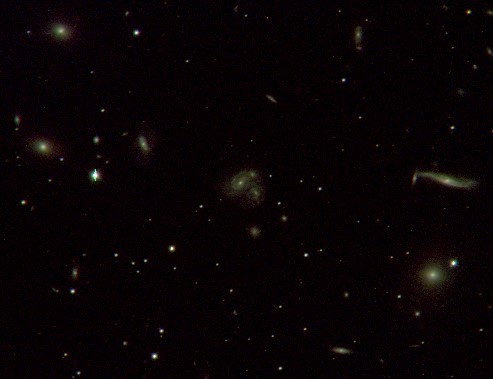
These images formed the centre of a Year 9 class activity during their Astrophysics topic. The students were given the red, green, and blue FITs files and shown how to create a colour image using an online FITs editor. Students classified the interacting galaxies as about to merge, merged, or already merged!
This facilitated lots of interesting discussions about the Physics behind galaxy mergers, galaxy evolution, and what happens when two black holes collide.
Comets
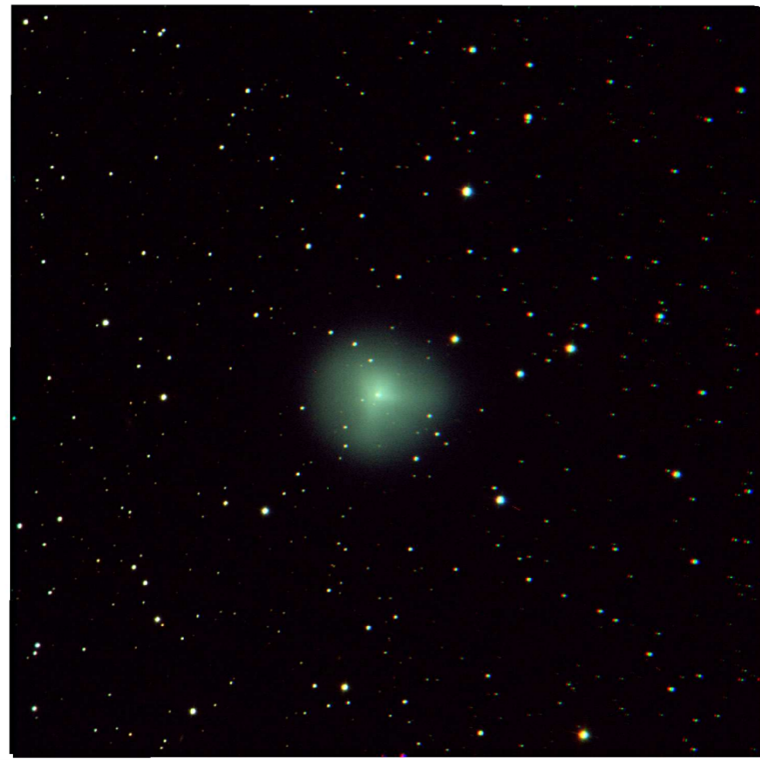
Last September schools were asked by the Faulkes Telescope Project to observe the Comet 29P/Schwassmann-Wachmann which had suddenly increased in activity, making it much brighter in the night sky. Our students readily accepted this challenge and managed to observe Comet 29P on two occasions using the 2-metre robotic telescope and another Comet (17P) undergoing a similar outburst.
We took this opportunity to learn about comets and made a model comet out of dry ice for our celebrations during World Space Week. Figure 2 shows one of our Comet images taken by our students.
A Level Astrophysics
As part of our Year 13 instruction, some students had the opportunity to use one of the telescopes during our daylight hours. After a few attempts at getting the telescope to face the live webcam the students could see the structure of the telescope was just like they had learnt about in class. Students had the opportunity to observe many of the objects we had been talking about throughout the course.
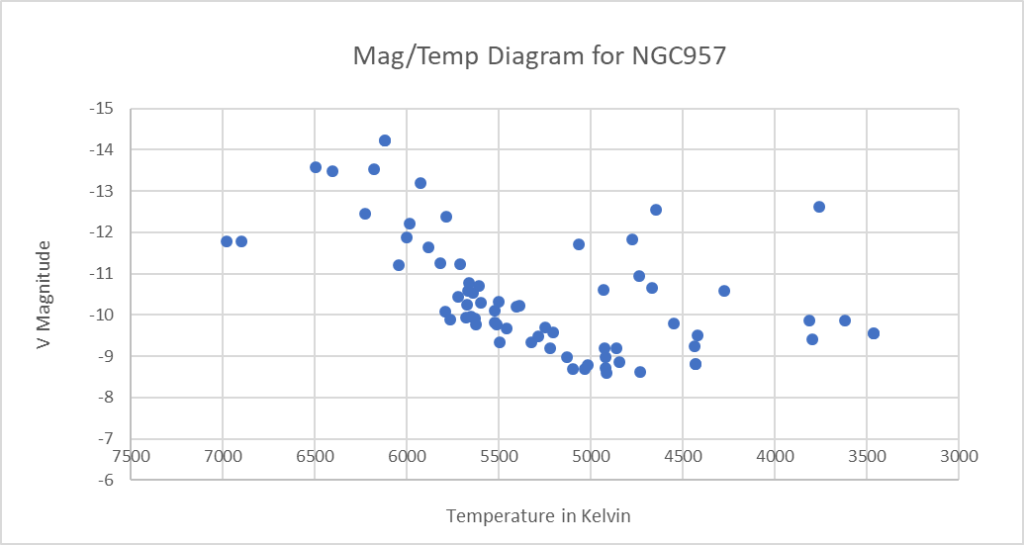
We then used data from the observatory archives to create our own colour-magnitude diagrams. Figure 3 shows a colour-magnitude diagram where the colour axis has been converted to temperature. Students were able to learn all about photometry and use special software to extract the magnitudes of stars in their chosen open cluster.
The experience of using the telescopes and creating images from them is invaluable for our students. As a Year 9 said “Wow, is that real?”. One of our younger Year 7 students said “The telescope was legendary, it took a beautiful image. It was super precise, allowing us to exactly see galaxies and all their features. The best telescope I have looked through.”
]]>
Much more happens in the sky every night than one might suspect with the naked eye. For instance, numerous automated observation programmes (e.g. Pan-STARRS on Hawaii’s Haleakala or the space-based WISE) continuously scan the sky for previously unknown objects that are potentially very close to Earth or even on a collision course.
The data obtained worldwide is then collected at the Minor Planet Center (MPC), and other observers are called upon to confirm the new discoveries and make supplementary measurements to predict the future orbit of such objects as accurately as possible.
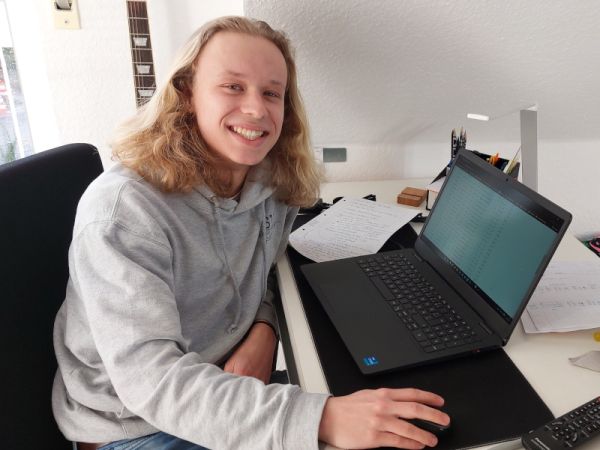
With the help of the Faulkes telescopes, it is possible for students to participate in this process and do real science. This is what Fred Alke (Figure 1) from the Oberstufe (corresponds to sixth form) of the Gymnasium Nepomucenum (Coesfeld, Germany) did in the context of a research project. In order to plan his observations, he first had to clarify which candidates from the MPC catalogue of objects currently in need of confirmation could be observed at all during his respective RTI (real-time interface) slots. This depends not only on the predicted position in the sky, but also on an acceptable signal-to-noise ratio: many of these objects move quite quickly and are relatively faint, which makes observation a challenge.
As a second step, Fred then analysed the obtained images. The usual procedure is as follows: first, with the help of suitable software, these images have to be aligned using the known positions of the stars they are containing. Then one can determine the position of the object of interest with a high degree of precision. After having done so, these measurements were transmitted by Fred to the MPC in a predefined format.
This way, Fred succeeded, among other things, in confirming the position of a new object, which has now been designated 2022 BJ6 and which turned out to be a Mars-crosser (an asteroid with an orbit that crosses Mars’ orbital path). One of the other objects he measured subsequently turned out to be the rediscovery of the already known main belt asteroid 2009 CH53. Fred’s measurements are published in the MPC’s official scientific publication, the Minor Planet Circulars.
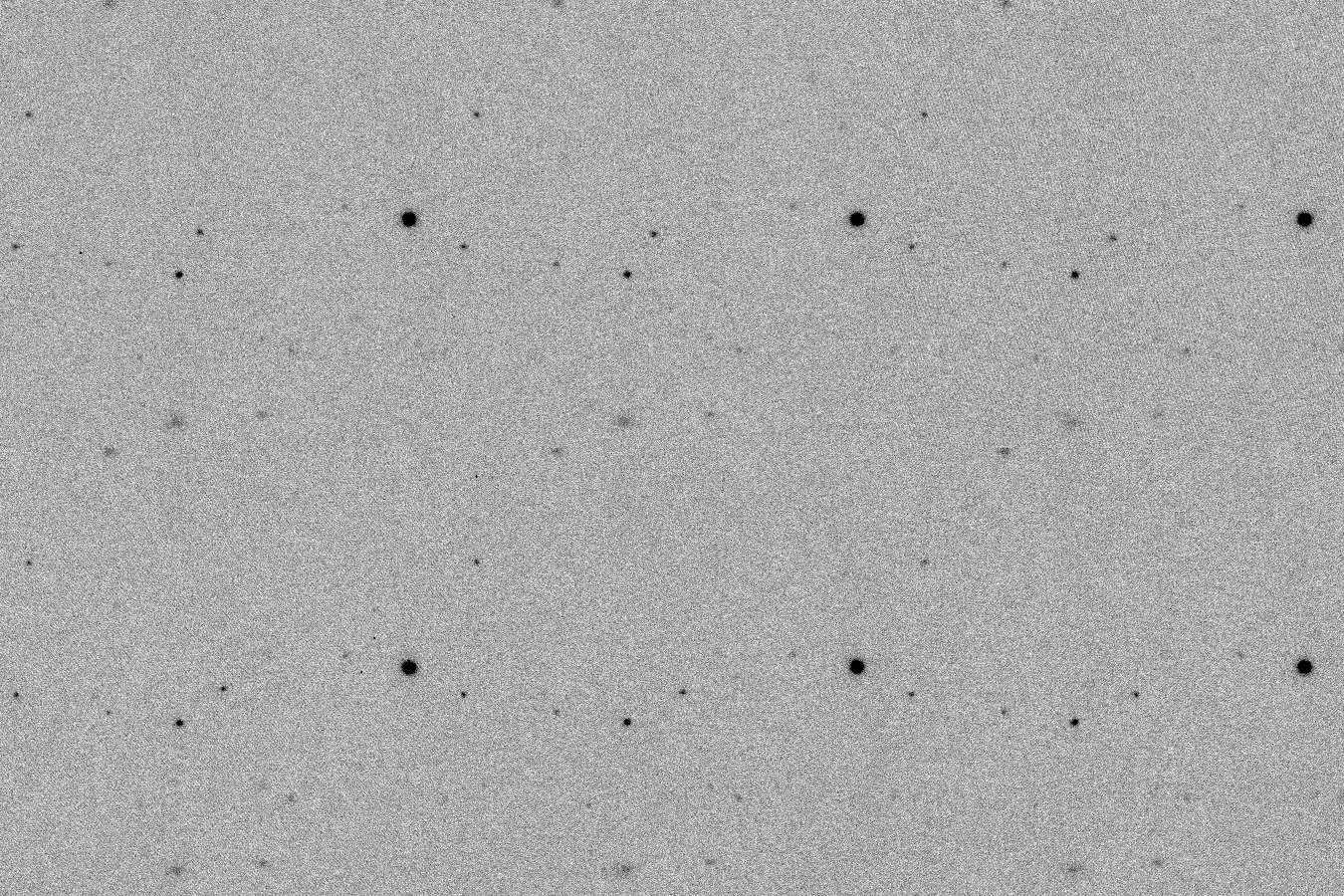
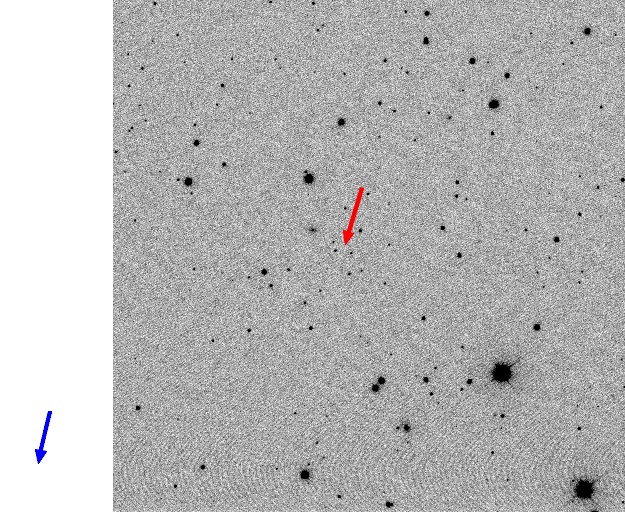
Another example vividly demonstrates that these activities have scientific relevance indeed: Fred’s attempt to observe the object 2022 CO6 failed at the position initially predicted. However, this prediction was based on only three WISE observations with an arc of a few minutes – no wonder that the orbital uncertainties were then still quite large. A few days later, after further observations of the object had been done, with the help of the updated ephemeris it turned out that at the time of observation it was probably just outside the field of view, which at about 9’x9′ is not too large with the Faulkes telescopes.
All in all, it can be said that the use of the Faulkes telescopes provides students with the possibility to work on authentic science, which definitely creates impressive experiences for them.
]]>
Children from four Welsh primary schools who are helping astronomers study a strange solar system object are now very excited to see their observations featured in a research paper recently published in the prestigious Astrophysical Journal.
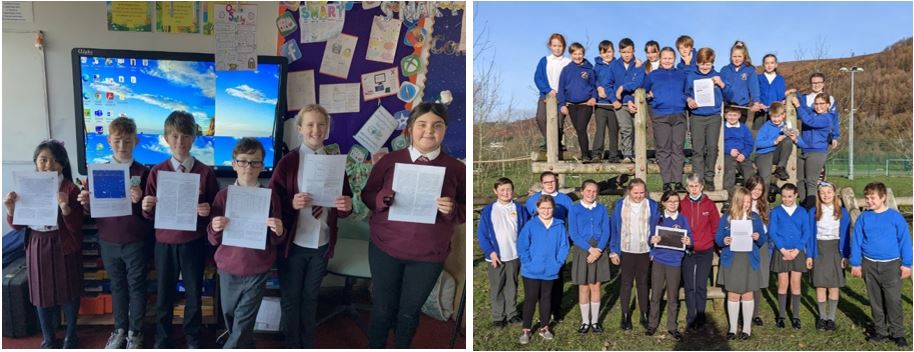
They are part of an innovative science education project called ‘Comet Chasers’ which links schools with professional comet scientists and amateur observers, around the world. Working with the Faulkes Telescope Project, schools have been observing and measuring the asteroid 2005 QN173 which developed an unusually long tail, a very rare behaviour normally only associated with an icy comet.
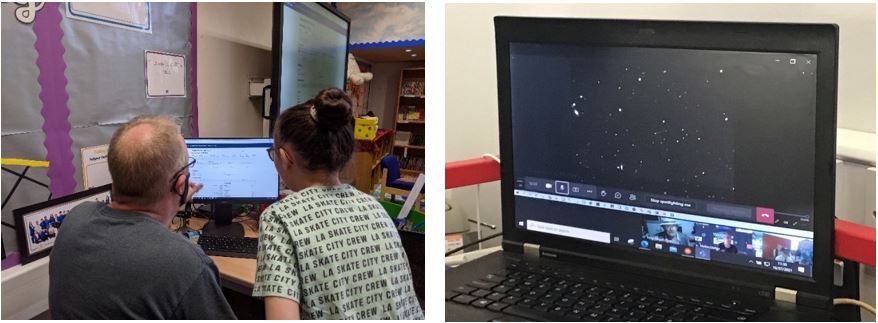
Children from St Mary’s Catholic Primary School in Bridgend, Ynysowen Community School, and Mount Street School in Brecon made research observations using the 2-metre Faulkes Telescope North in Hawaii. Montgomery Church in Wales School in Powys is helping with the ongoing observations. The specific observation parameters were agreed with Dr Henry Hsieh from the Planetary Science Institute in the USA, who is leading an international study of this strange object.
Dr Hsieh is the lead author on the new paper, with the Comet Chasers team as some of the co-authors. Dr Hsieh is very grateful for the data provided by the young Welsh astronomers: “The Faulkes Telescope observations collected by the Comet Chasers students really helped our study thanks to some of the unique capabilities of the telescope, and the speed of response to requests for observations”, he said. “We’re very happy to have these students and their teachers and mentors be able to make real contributions to this research and are looking forward to continuing working with Comet Chasers students in the coming year.”
Mr. Wooding is a teaching assistant at St Mary’s, Bridgend, and is a co-author on the research paper. He commented “The children at St. Mary’s Catholic Primary School are very excited to play a part in the data collection for asteroid-comet 248370. We’re very grateful to Helen Usher and the Comet Chasers project for giving our children the opportunity to undertake real science using professional astronomical equipment for the collection and analysis of important and significant data.“
The children at Ynysowen said they loved every minute of the Comet Chasers project. “Having total control of a big telescope was so much fun”. They were so excited to see the observations they have made being used for finding out more about this strange object, and particularly seeing their school’s name in the paper!
The newly published research reveals more details of this intriguing object, now re-classified as a Main Belt Comet (Comet 433P) as it shares characteristics of both a Main Belt asteroid and an icy comet. Discovered in 2005, it appeared to be a typical asteroid in the Main Belt of asteroids between Mars and Jupiter – looking like a moving, star-like point of light. But this year its appearance was completely different, as it developed a thin straight tail. Such objects are rare – only 20 have been observed so far.
These objects are interesting because a substantial part of Earth’s water is thought to have been delivered via asteroid impacts when the Earth was being formed. The observed activity of these objects means they are likely to still contain ice. They therefore offer a way to test this hypothesis and to learn more about the origins of life on Earth. We are learning more about the abundance, distribution, and physical properties of icy objects in the inner Solar System.
The research suggests that the nucleus of 433P is about 3.2 km across and is surrounded by a dust cloud. In the children’s observations, the tail was measured as over 720,000km long, but just 1,400km wide. The narrow tail tells scientists that the dust is barely floating off the nucleus at very slow speeds. The flow of gas (which usually is the cause of dust escaping a comet) is very weak, which raises questions for future study: ‘What is causing the dust to escape?’ ‘Is it a fast-rotating object flinging off material from its surface?’. The Welsh Comet Chasers are continuing to make observations, and so they will be helping to try to solve these mysteries too.
There is more excitement to come too. The Comet Chasers schools are observing other comets for different research projects, including the BAA/Richard Miles Mission 29P observing campaign. And two further research papers are already being drafted using Comet Chasers observations.
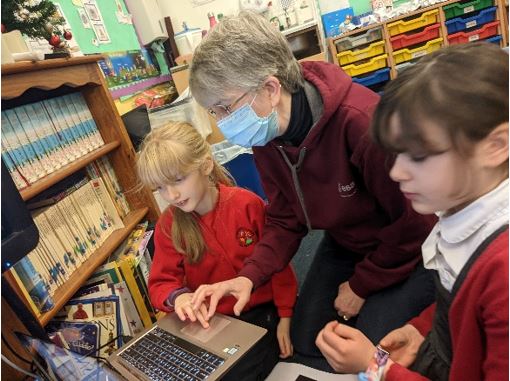
The schools also stand ready to respond quickly to requests for observations for new objects or where unusual activity is noted. Their quick access to the large telescopes of the Las Cumbres Observatory network of telescopes, through the Faulkes Telescope Project, really aids professional researchers who usually have to plan observations months in advance. The collaborations are certainly proving fruitful for everyone.
The project is about much more than just the scientific output though. The Comet Chasers team has been providing educational resources and hands-on support to teaching staff, allowing them to use the ‘Wow’ factor of space to engage and inspire learning across the curriculum. The enthusiasm of the teaching staff in each school, along with the support of BAA members, has been key to the project’s success so far.
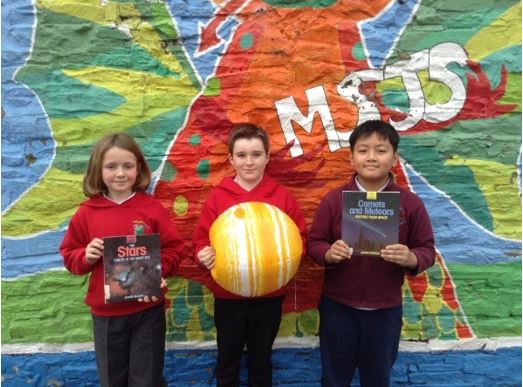
The team would be very happy for other schools to join the Comet Chasers project too! Contact Helen Usher, helen.usher@open.ac.uk for more information.
]]>What do I need to do?
If you can help then it is best to take exposures of 60 seconds duration using all three filters (red, green and blue), in a sequential manner on the 2m telescopes. If you can take 10 frames then that should be sufficient.
On the 1m telescopes, please take single 120 s exposures with g’ and i’ and then a series of 120 s exposures through r’ to go deep into the outburst coma.
Anything else?
If you have time afterwards then please repoint the telescope to Comet 17P/Holmes and take as many 120 seconds duration exposures again using all 3 filters. Comet 17P is famous for an outburst that happened in 2007 when it became 400,000 times brighter than normal. Maybe it will have another outburst whilst you are observing! It’s last one was this August.
Where is Comet 29P/S-W1?
The daily positions for Comet 29P can be found on our monthly targets page.
Step-by-step instructions
1. For the target, use the name ” 29P ” (or ” 17P ” see below)
2. Enter the RA position. For September 30 and 29P this would be ” 04 57 45 ”
3. Enter the Dec position. For September 30 and 29P this would be ” +31 52 53 ”
N.B. You will need to look at the URL to select the actual RA and Dec positions for the day you wish to observe the comet.
4. Now tick the box for ALL three filters and in the exposure time line , enter ” 60 ” for each of them
5. When the ‘Go’ button lights up bright green then click on it and wait. In the top right of your screen you will see what the telescope is doing as well as the countdown clocks. When the image(s) have been taken and saved, the ‘Go’ button will light up green again so just click on it and repeat the series for a total of 10 exposures.
If you have time, please repoint the telescope and repeat the exercise but this time looking at Comet 17P and using the name ” 17P ”
N.B. You can be filling in the new name, positions and exposure times even whilst the telescope is taking an exposure
Use exposure times of ” 120 ” seconds for each filter.
The positions of Comet 17P to point the telescope at are given in the table below (depending on which day you are observing):
Date RA Dec
Sep 30 05 50 51 +45 09 04
Oct 1 05 51 38 +45 15 11
Oct 2 05 52 23 +45 21 17
Oct 3 05 53 06 +45 27 22
Oct 4 05 53 47 +45 33 27
Oct 5 05 54 26 +45 39 31
Oct 6 05 55 03 +45 45 35
Oct 7 05 55 38 +45 51 37
Oct 8 05 56 11 +45 57 39
Oct 9 05 56 42 +46 03 39
Oct 10 05 57 11 +46 09 39
Oct 11 05 57 38 +46 15 37
The students compiled a detailed report they titled: ‘Protocol for the Observation of an Exoplanet Transit for Beginners… a Simplified Version for the Choice, the Observation and Analysis of a Target using the LCO’. The report provides a useful step-by-step guide for identifying, observing and analysing exoplanet targets.
The students wrote: “The whole idea of this protocol appeared after we started our CIRI project at IPSA. We soon realised that, to choose a target for observation, a lot of parameters had to be considered, thus resulting in a rapidly disorganized and rather chaotic research”.
In their report, the students explain the processes they went through when choosing an exoplanet target for observation, including telescope availability, weather and Moon visibility. They then produced a list of potential targets before identifying their final choice of target.
The students utilised a number of sources to identify all this important information, demonstrating the work and attention to detail that is often required to obtain successful observations.
After obtaining successful observations of their target, the students performed photometric analysis and produced a light curve of the exoplanet’s host star. Their results are displayed in Figure 1 where the dip in the light curve indicates the passing of the exoplanet in front of the star in relation to our point of view on Earth.
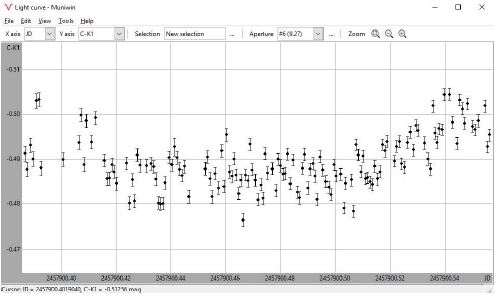
The students’ lecturer, Anica Lekic had this to say: “As far as my students are concerned, they are in a 20-hour project in the form of a course on exoplanets and they are in a master’s degree in engineering school. It is a master’s degree in aeronautical and space engineering. They are not destined to be astronomers but some of them may work in this field so this type of project is very appealing to them.”
]]>