 Via our parent organisation, the Dill Faulkes Educational Trust (DFET), we at the Faulkes Telescope Project are proud to be leading an EU Erasmus+ project called LaSciL.
LaSciL stands for Large Scientific infrastructures enriching online and digital Learning and aims to support high quality science teaching, through the use of data archives and innovative online tools.
Along with our colleagues in Greece, Portugal and Austria, we are supporting teachers in using these tools to:
-
create educational resources for students in open and distance learning;
-
manage large numbers of students in an online environment and keep them motivated to participate;
-
personalise teaching practices based on students’ needs.
As with many EU projects, LaSciL will is running a couple of ‘summer schools’. In 2022, we were lucky enough to visit Heraklion in Crete. In February 2023, it will take place in a dark sky reserve called Alqueva in Portugal. We have funding to provide UK teachers with flights and accommodation for these weeklong trips so if you’re interested, please contact us.
More details can be found here for the project (https://lascil.eu/) and the summer school (https://esia.ea.gr/lascil-winter-school-2023/).
Or contact us for more details by emailing fraser.lewis (at) faulkes-telescope.com

From the 17th – 21st October, ESAC in Madrid will host this year’s Galileo Teacher Training Program as a face-to-face and online event.
ESAC, ESA’s window to the Universe, welcomes teachers from all over the world. You’ll be able to meet the scientists, visit the facilities, and learn about the discoveries taking place there. The program will include presentations by scientists, hands-on activities, digital tools, research activities, visits to the facility and observing sessions with telescopes at ESAC.
The training is organized by CESAR (Cooperation through Education in Science and Astronomy Research), the resident educational team at ESAC, and NUCLIO with the support of the team from the IAC (Instituto de Astrofisica de Canarias), the Faulkes Telescope Project and the National Schools’ Observatory.
Participants will have opportunities to network and to establish a series of research projects in partnership with their colleagues and the scientists supporting the training. Take part in this training course and go back to your school with a research project in your hands.
You can find out more here
]]>
The Global Hands-On-Universe Conference gathers Astronomers, Educators and Scientists from several fields of knowledge to exchange ideas for hands-on science education. Among the highlights of these practices, you’ll find using real-time remote telescopes, real science experiments in the classroom, and development of fundamental scientific skills in teachers and students. The mission is to promote interaction between different countries, and engage teachers and students in a global science education cooperation where inclusion and equality are key.
Submit an abstract for an oral presentation or workshop, or register as participant only. The deadline for abstract submission is the 31st of July. The registration fees will be donated to the NUCLIO Trust programme (https://trust.nuclio.org/) to help students from developing countries to pursue university studies.
More information and registration at https://
The workshop focused on the various opportunities available to people who are active in astronomy education, whether as practitioners or researchers. The workshop sought to answer the question: in an ideal world, what are the things all of us in the astronomy education field should know?
Fraser presented a talk in the ‘Astronomy Education with Authentic Data’ session where he showed examples of IBSE (Inquiry-Based Science Education) activities, designed to be “teacher-free”, and used as extended projects for students of astronomy and space science.
Each of these activities uses data and resources from the Faulkes Telescope Project and the National Schools’ Observatory. They are based on open clusters and exoplanets and also use data from Type Ia supernovae, all of which provide an insight into the scientific process. The supernova activity allows users to perform browser-based photometry (using JS9) on images to add additional data-points to the Hubble Plot, enabling them to measure the expansion rate and age of the Universe. Fraser was also part of the selection committee for talks in the ‘Remote Observing’ session.
You can watch Fraser’s talk here.
Anita presented the ‘Europlanet Evaluation Toolkit’, a set of simple data collection and analysis tools designed for easy integration into outreach and education activities to help evaluate their effectiveness and impact. The toolkit is available as a set of interactive webpages and a downloadable pdf, and can also be ordered as a hard copy in the form of a booklet and set of activity cards.
You can watch Anita’s talk here.
Sophie presented ‘How did that happen?: Mixed-method evaluation of astronomy resources’ that used her PhD research to demonstrate what practitioners can learn from astronomy education interventions through implementing mixed-method evaluation. Sophie described how by using quantitative methods (e.g. numbers and figures) to identify what happens, and qualitative methods (e.g. words and descriptions) to identify why this happens and under what circumstances, practitioners can gain a more holistic understanding of the impact of their interventions.
You can watch Sophie’s talk here.
The full workshop proceedings are available online on the IAU website here.
]]>
Teachers, students, educators, and other scientists are invited in an amazing journey with Global Hands-On Universe (GHOU). Teachers are re-energised about their discipline, students can do real science, students are inspired about careers in STEM disciplines and learn IT skills, etc.
Last year, the GHOU Online Conference received an amazing response from the community, with over one thousand registered participants from 85 different countries. The full program spanned over 100 hours of content, which could be followed live by registered participants via Zoom, and by anyone else interested using GHOU’s Facebook page. These numbers made the GHOU Conference 2020 one of the largest online events in the field of Astronomy Education of all time. This sets a high bar for this year’s conference. Be a part of this online adventure and share your work with the world!
You can register as a participant or submit an abstract until the end of July. More details here
]]>After the success of the last edition, held entirely online and in which some 200 teachers from more than 40 countries participated, the International Summer Course Astronomy Education Adventure in the Canary Islands repeats the format, with the aim of contributing to curb the pandemic of COVID-19 and reach more participants in a sustainable way.
The contents of this seventh edition, to be held between July 26 and 30, will focus on the Solar System, with nods to the TV series “COSMOS: A Personal Voyage”, by the astrophysicist and science popularizer Carl Sagan, to commemorate the 40th anniversary of its first broadcast (in 1980 in the USA and between 1981 and 1982 in Spain and other countries).
The training will be given in English and in virtual mode, using the videoconference software ZOOM. It will last 27 hours and will be certified by the IAC and NUCLIO, within the framework of the European project Galileo Teacher Training Program. It is aimed at teachers of all educational levels and subjects who wish to immerse themselves in a real experience with the STEAM (Science, Technology, Engineering, Arts and Mathematics) areas.
Registration will be open until July 15 (or until all 250 registrations are received) and places will be assigned on a first-come, first-served basis.
The course is financed by the organizing and collaborating institutions. In this edition it has been decided to include a symbolic registration fee (10 Euros) that will go entirely to the NUCLIO Trust program to support students from developing countries to pursue university studies. Those teachers who cannot afford this donation may request a waiver of the fee.
Find out more here
]]>Helen Usher, a member of the Faulkes Telecope Project and PhD candidate at the Open University will be presenting at the National Astronomy Meeting (NAM) this year. NAM brings together a number of astronomy-related communities across the UK to present a wide-reaching programme that demonstrates the diversity and interests of these communities.
Helen will be talking about the ‘Comet Chasers’ project and the activity of herself, Paul Roche, Colin Snodgrass, Tony Angel, Richard Miles, Ben Wooding and Sam Wooding.
The STFC-funded ‘Comet Chasers’ project, working with primary schools in South Wales, was designed to use comets as the focal point for practical activities to teach the scientific method and elements of the STEM and broader curriculum in a fun and engaging way. It also seeks to change attitudes and aspirations with regard to science and careers. We present details of the project and its results.
The project was initially designed to be centred on a day-long visit to six primary schools, with some optional follow-up activities (e.g. making comet observations with the Faulkes Telescope Project). With Covid restrictions, the project was deferred, and then redesigned for virtual and teacher-led delivery.
As well as providing background information/activities about comets, the project seeks to engage schools in real science, making observations and analysing the results, supported by professional-amateur comet researchers.
Some of the analysis to be undertaken requires understanding of new concepts e.g. varying exposure times, the use of filters, astrometry, photometry, and lightcurve production and interpretation. Hands-on demonstrations and experiments, using everyday analogues, were devised to help students understand these concepts. They range from physical filtering of beads, through to a (loan) kit based around a simple motorised turntable, torch and webcam, and bespoke software, which allows pupils to see light curves of objects generated in real-time. Hence spinning a rubber duck (analogue for Rosetta’s comet 67P) and a potato (analogue for asteroids). Students are also encouraged to test other objects to see the link between the shape of the light curve and their physical and rotational properties. This element of the project will have wider potential for use in future projects (simulating e.g. eclipsing binaries, exoplanet transits and pulsars).
To find out more about the National Astronomy Meeting 2021, you can check out their website here.
]]>The recent Maui County district Science and Engineering Fair saw a number of successes involving schools’ programmes using the telescopes.
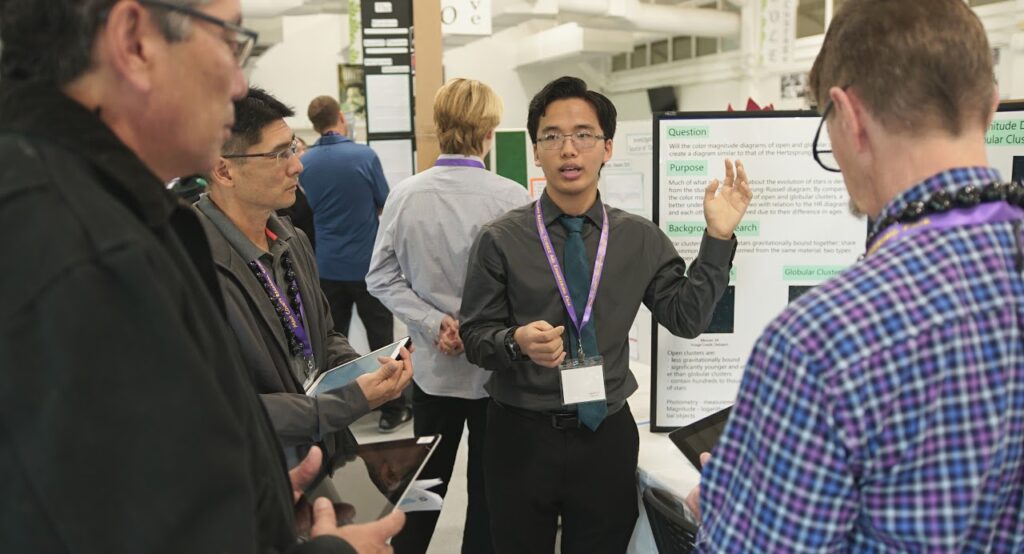
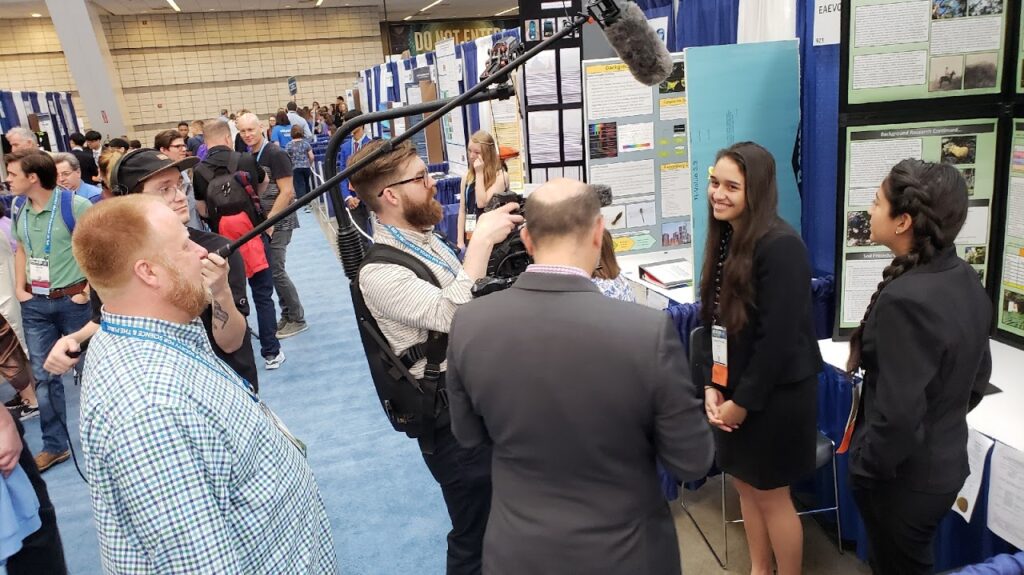
This year the science fair was held virtually, and was considerably smaller, and with fewer awards. This was more difficult on the students, and so our congratulations to all the students who entered, and did so well with their astronomy-themed research projects:
Anica Anchetta attended the HI STAR program in 2020 and 2019. Anica has been using data from the Las Cumbres Observatory (FTN/FTS and 1.0-meter network) studying an active galactic nucleus. At the science fair she received the following awards: Air Force Award 1st place for Senior Division of Theoretical Sciences Hawaii State Science and Engineering Award (which allows Anica to proceed on to the State Science and Engineering Fair) 3rd Place Senior Division Grand Award. Along with Anica, we wanted to congratulate her mentor, Anna Payne, a graduate student at IfA Manoa working for Ben Shappee.
Edward Divin attended HI STAR in 2020 and in 2019. He has been working on creating an observational technique to measure the diameter of asteroids on the LCO network, by observing occultations. He received: The Hawaiian Electric Award Maui Economic Development Board Senior Research Award 2st place for Senior Division of Theoretical Sciences Hawaii State Science and Engineering Award (which allows Edward to proceed on to the State Science and Engineering Fair).
Luke Berrigan attended the HI STAR program in 2018, and again in 2020. He has been working on determining the origin of ‘Oumuamua. Last year Luke worked with data from LCO to investigate the origin of ‘Oumuamua. This year he modelled gravitational boosts and calculated the required delta E to estimate the significance of last year’s finding. He was awarded: Mu Alpha Theta Award for mathematics (Luke’s younger sister also won several awards, including the junior division grand award. Science must run in the family!)
Blake Pagdilao worked with a member of RCUH to measure the time lag of the Twin Quasar. Blake used observations from the PanSTARRS data release. He was awarded: 3rd place for the Junior Division of in Theoretical Science Hawaii State Science and Engineering Award (which allows Blake to proceed on to the State Science and Engineering Fair).
Elias Tokuoka also worked with a member of the RCUH community measuring an exoplanet transit. He was using observations provided by LCO. He was awarded: 2nd place for the Junior Division of in Theoretical Science Hawaii State Science and Engineering Award (which allows Edward to proceed on to the State Science and Engineering Fair) .
Holden Suzuki and Wilson Chau worked together again this year. Holden has attended HI STAR for the last three years and Wilson for the last two. This year Holden and Wilson analyzed LCO observations of LD2 to determine the cause of its cometary outburst. They received the following awards: 1st place for the Junior Division of in Theoretical Science Hawaii State Science and Engineering Award (which allows Edward to proceed on to the State Science and Engineering Fair).
Esken Guarin attended HI STAR in 2020 and 2019. This year he was granted some engineering time on the MuSCAT 3 instrument which was installed on the Faulkes Telescope North in October of last year. This makes Esken one of the first researchers to use the new instrument. He used the observing time to determine the Tholen Spectral Type of asteroid David Tholen. Esken received: 3rd place for the Senior Division of in Theoretical Science Outside of the Science and Engineering Fair.
Jed Orion Teagarden was recently published as a co-author on the paper “First Remote Student Speckle Interferometry Double Star Observations on the InStAR Student Robotic Telescope Network”. Orion attended the HI STAR program for the last three years. He is not new to professional grade research. He has been on 12 Minor Planet Circulars.
We want to invite you all to join us in congratulating these young scientists on their work!
]]>In the afternoon, Helen Usher and Paul Roche (FTP), working with Richard Miles and Tony Angel of the British Astronomical Association (BAA) working with 13 primary school teachers to kickstart the STFC-funded “Comet Chasers” project, being led by Techniquest science discovery centre in Cardiff Bay. The teachers were introduced to comets, and also to galaxies, as the project will be using the example of Charles Messier, who developed his famous catalogue of “deep sky objects” to avoid confusion with his comet hunting. The Comet Chaser schools will be working with FTP and the BAA to gather data on several comets that will be visible in March – May, before (hopefully!) coming together for a big finale event at Techniquest in July.
Later that day, Paul was back in action with IOP Wales, in an early evening session entitles “Observing the night sky – stars and Mars”, this time working with Pete Williamson (AstroRadio and Solarsphere) and Emma Wride (AstroCymru). At it’s peak there were 79 (mostly secondary) teachers in the audience, learning about how to use Stellarium to locate objects in the night sky. A planned “go outside and watch the ISS and Starlink satellites go over!” event in the break was scuppered by bad weather for almost all the participants, although a luck few (notably in the Anglesey area!) did manage to catch the impressive overpasses.
The ESERO-UK website, and in particular the substantial classroom resource archive, were showcased, as well as various pieces of free software and websites that will assist the teachers in using astronomy and space as topics to inspire their students.
In total, just over 6 hours of CPD was delivered to just over 90 teachers – a great start to the year, and an indication of the power of online delivery for reaching large numbers of teachers across the country!
]]>